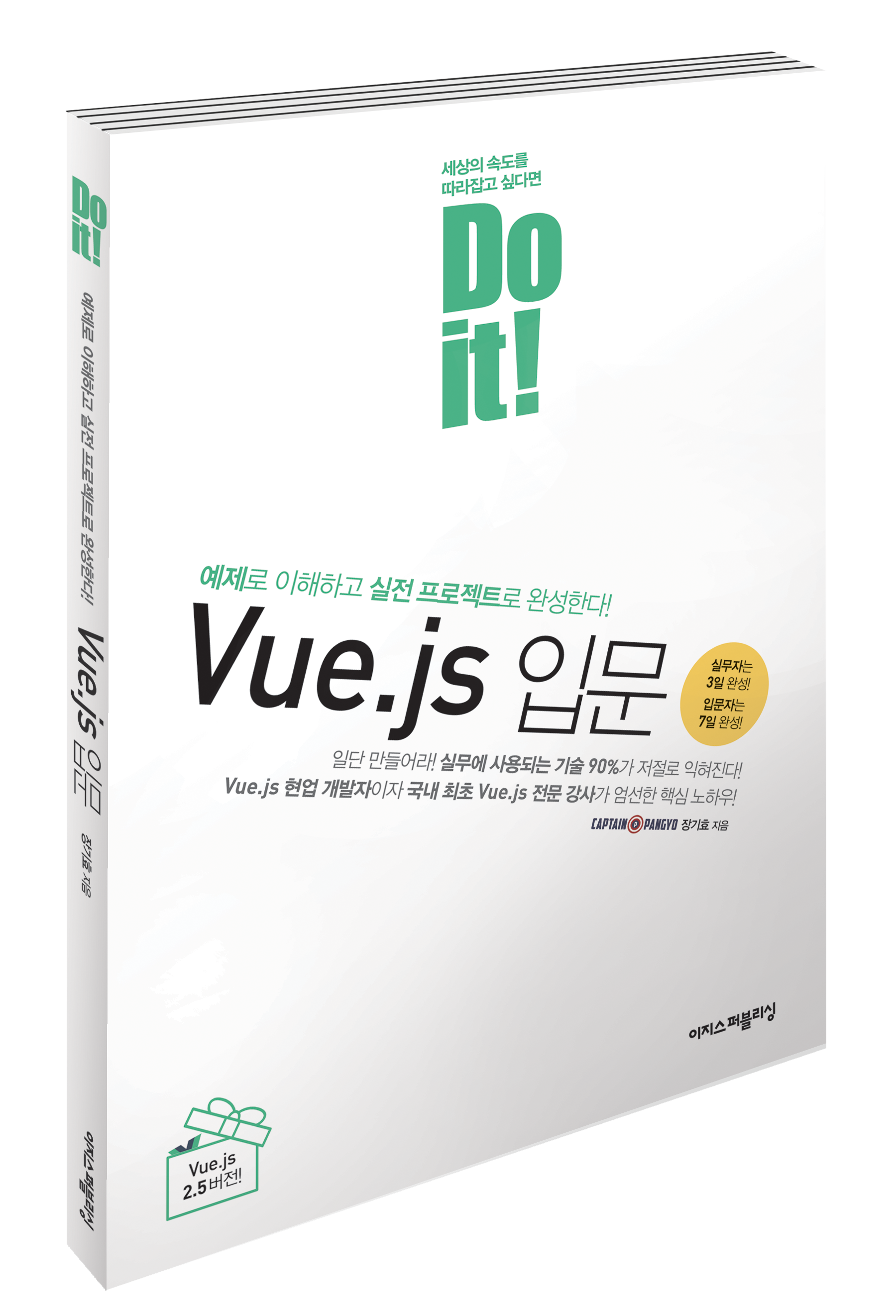

Book Review: Do it! Vue.js
JavaScript is hard for me. To begin with, the language itself is quite confusing. On top of that, new technologies appear practically every day. They are far too attractive to simply brush off as “oh, here’s yet another new thing,” so you can’t afford to miss them either. Meanwhile, time has passed, and at some point JavaScript has reached a state where knowing only the language itself gets you nowhere. The barrier to entry has risen, and I don’t even know where to start. And even if I were fairly comfortable with it myself, getting other developers I have to collaborate with to understand JavaScript and its ecosystem has become incredibly difficult. I’d like to believe I’m not the only one going through this.
In this situation, Vue.js has considerable advantages. Above all, it’s easy to learn. Now that using a frontend framework is practically mandatory if you do web development, the advantage of being able to learn it and put it to use right away is huge. In my own case, just by following the tutorial I was quickly able to build a ToDo app, and with the skills I gained from that alone I could immediately build a product in a real project. Of course, since I had been developing with AngularJS, it probably felt easier to me, but even so, it was far easier to learn than React or Angular.
I could have stopped there and been fine, but my philosophy is that if it’s a technology you’re going to use as your main tool, you should at least work through one book. So the book I picked up was Do it! Vue.js. The strengths of this book are clear. The explanations are remarkably thoughtful. You can feel the traces of countless deliberations that went into making it easy for readers to understand. I started reading thinking I was already past the beginner stage with Vue.js, but it turned out to be a great opportunity to correct concepts I had glossed over while leaving them vague and fuzzy. In particular, I dare say the explanation of the lifecycle couldn’t be any better.
Of course, there are downsides too. Giving only a brief explanation of Vuex along the lines of “there’s this thing, and you’ll need it later,” and not mentioning plugins at all, could be seen as a problem if you want to call it one. Not knowing these things makes development extremely difficult. I suspect this is because the book was written assuming a complete beginner who can’t even install Atom yet and is starting to study without feeling overwhelmed. Looked at this way, it’s not a major flaw.
Finally, I’d like to add one more nice point about this book. It kindly explains the JavaScript ecosystem — things like webpack, NPM, and ES6 that are essential for JavaScript development but that nobody really teaches you separately. The explanations are brief, but they say everything that truly needs to be said. This is probably part of why I like the author, Captain Pangyo.

Leave a comment