A Study on the Relationship Between Chimmidarye and Tamna
The paper below was written as a formal paper using GPT4.5 deep research, based on the following argument of mine.
“The prevailing theory holds that Chimmidarye was located near present-day Haenam, and that Tamna was present-day Jeju Island. This is a persuasive argument. However, the argument that Chimmidarye may have pointed to Tamna also has its own persuasiveness. In the study of ancient Korean Peninsula history, where historical sources are extremely scarce, it is heartbreaking to throw away historical records simply because they do not fit the prevailing theory. So I would like to throw out a hypothesis for which I cannot take full responsibility. Given that Chimmidarye was a regional hegemonic state that ruled over several small states, it would not be strange if Chimmidarye had subjugated Jeju Island and turned it into a vassal state. The frequent trade between Jeju Island and southern Jeolla Province is also proven archaeologically, and although Jeju Island is a large island, it lacked salt and grain, making self-sufficiency difficult. If we suppose that, after events such as Empress Jingu’s slaughter of Chimmidarye, Chimmidarye became subordinate to Baekje but remained under indirect rule, and that Tamna (Jeju Island), taking advantage of the power vacuum, broke away from Chimmidarye’s sphere of influence and began to stand on its own, then we can explain the appearance, by the 6th century, of Tamna in various histories as an independent polity and clearly an island nation.”
It is not particularly excellent as a paper, and much of it consists of miscellaneous material scraped together from the internet such as Wikipedia and Jeju News, but it seems decent as a starting point for a paper.
A Study on the Relationship Between Chimmidarye and Tamna
Ⅰ. Introduction
The **Kingdom of Tamna (耽羅)**, which existed on ancient Jeju Island, has traditionally been recognized as an independent maritime kingdom. However, some researchers raise the possibility that Tamna was not a completely isolated state, but was instead incorporated as a vassal state (屬國) or tributary state under the sphere of influence of Chimmidarye in the southwestern part of the Korean Peninsula. Chimmidarye is presumed to have been one of the ancient Mahan (馬韓)-affiliated maritime powers appearing in the literature, a group that, from the 3rd century onward, built a powerful maritime trade network in the Yeongsan River basin and the surrounding island regions. This paper examines the literary historical sources and archaeological evidence supporting this hypothesis, and thereby considers the validity of the argument that Chimmidarye made Tamna its vassal state. To this end, it first examines the records of the relationship between Chimmidarye and Tamna found in the ancient literature of China, Japan, and Korea, and then analyzes the archaeological excavation results of the Haenam region (the presumed home base of Chimmidarye) and Jeju Island (Tamna) in order to clarify the exchanges and political relationship between the two powers. Through this examination, the paper seeks to logically demonstrate the possibility of a Chimmidarye-Tamna alliance relationship that has been overlooked in the existing prevailing theory.
Ⅱ. The Relationship Between Chimmidarye and Tamna as Seen Through Literary Sources
1. The Island Nation of Tamna and the Maritime Powers of the Southern Sea as Recorded in Chinese Histories
The earliest mention of Tamna appears in the 3rd-century Chinese 《Records of the Three Kingdoms (Sanguozhi)》, in the Account of the Eastern Barbarians in the Book of Wei. According to it, *“in a large island in the western sea of Mahan there is a people called Juho (州胡)”*(en.wikipedia.org, zh.wikipedia.org). Juho is identified with Tamna, and it is recorded that, although their language and culture differed from those of the Korean Peninsula, they traveled by boat to and from the land of Mahan to trade(en.wikipedia.org). This record shows that already around the 3rd century, the inhabitants of Jeju Island had formed close trade relations with the Mahan power in the southwestern part of the Korean Peninsula. The 《Book of the Later Han (Hou Hanshu)》 also contains similar content, confirming that Tamna (Juho), as an island nation in the western sea of Mahan, exchanged with the Korean Peninsula mainland(zh.wikipedia.org).
In the histories of China’s Northern and Southern Dynasties period, records appear of the diplomatic activities of Tamna and related powers. For example, there is a record that in the late 3rd century a collective embassy was sent to the Western Jin (西晉) court by the **“Sinmi Empire (臣彌帝國),” which represented 29 small states of the Yeongsan River basin**(dspace.kci.go.kr), and scholars interpret the Sinmi (臣彌) power mentioned here as belonging to the same lineage as the later Chimmidarye. This suggests that within the Mahan confederation, the **Sinmi State (臣彌國)**, the predecessor of Chimmidarye, had attained an international standing sufficient to gather the surrounding small states and dispatch a tributary embassy to China(dspace.kci.go.kr). In other words, it can be seen that the entire maritime power of the southern sea, including Tamna, had early on conducted its external relations as a political alliance centered on Chimmidarye = the Sinmi State.
In addition, in the memorial of a Goguryeo envoy sent to the Northern Wei (北魏) in the early 5th century, the name Seopra (涉羅), presumed to be Tamna, appears. In a document submitted by King Munja of Goguryeo (文咨明王) to Emperor Xiaowen of Northern Wei in the late 5th century, it is mentioned that *“Buyeo was driven out by the Mohe, and **Seopra (Tamna)** was annexed by Baekje, making it difficult to offer gold and jade (珂玉)”*(ko.wikipedia.org). If Seopra is taken to be Tamna, this means that Tamna was annexed by or subordinated to Baekje and could no longer independently offer its products as tribute to Goguryeo(ko.wikipedia.org). This shows that around the late 5th century, as Baekje took control of the maritime rights of the southern sea, it exercised dominance over Tamna, and that until then Tamna had maintained a considerable trade relationship even with Goguryeo. In the end, the Chinese histories suggest that Tamna had maintained tributary and trade relations with the surrounding great powers within the maritime power sphere of the southern sea, and that by around the 5th century it had come under Baekje’s interference.
2. Baekje and Tamna: The Tributary and Subjugation Relationship as Seen in the 《Samguk Sagi》
The **Korean source, the 《Samguk Sagi (History of the Three Kingdoms)》**, is the key material conveying the direct interactions between Tamna and Baekje. According to the “Annals of Baekje” in the 《Samguk Sagi》, in the **2nd year of King Munju of Baekje (476)**, it is recorded that *“the Kingdom of Tamna offered local products (方物) and other native goods, and the king, pleased, enfeoffed the king of Tamna with the rank of Eunsol (恩率)”*(mediajeju.com, jejunews.com). “Local products” refers to regional specialty tribute goods, and the fact that the Baekje king conferred upon the king of Tamna the official rank of Eunsol at this time is interpreted as a measure intended to incorporate Tamna as a vassal state within the Baekje official ranking system(mediajeju.com). In fact, the local products offered by Tamna were of the nature of ordinary tribute goods, showing that at the time Baekje, while recognizing Tamna’s autonomy to a certain degree, treated it nominally as a subject(mediajeju.com). This means that until before the late 5th century, Tamna maintained its own royal authority while standing in an allied relationship of offering tribute to Baekje.
This relationship transformed into a more subordinate form about 20 years later. By the **20th year of King Dongseong (498)**, when Tamna failed to pay the tribute taxes (貢賦), that is, the tax tribute, promised to Baekje, King Dongseong of Baekje is said to have used this as a pretext to advance south to conquer Tamna(jejunews.com). It is recorded that the Baekje army advanced south as far as Mujinju (武珍州), and that the alarmed Kingdom of Tamna hurriedly sent an envoy to apologize and sue for peace, whereupon the king turned his troops back(ko.wikipedia.org). Through this event, Tamna appears to have once again pledged loyalty to Baekje and resumed its tribute, and the compiler of the 《Samguk Sagi》 evaluates that **“Tamna was a tributary state (附庸國) that maintained its relationship by paying tribute taxes to Baekje”**(jejunews.com). In the end, it can be seen that, from 498 onward, Tamna effectively underwent **vassalization by Baekje**. It is recorded that Baekje did not merely grant the king of Tamna a title, but intervened actively to the extent of directly dispatching figures such as **Naebeop-jwapyeong Go Jinno** to Tamna to survey the terrain(ko.wikipedia.org). This is a passage showing that Baekje’s governance and supervision over Tamna had begun.
What is interesting is that, unlike this account in the 《Samguk Sagi》, the Tamna-side tradition remembers this period as diplomacy led by Tamna itself. According to the records of the Kingdom of Tamna, the offering of local products in 476 occurred during the reign of Tamna’s King Dam (聃王) and was not a political subjugation but an independent diplomatic activity, and the peace pact concluded with Baekje around 498 during the reign of King Jiun (指雲王) is likewise recognized as an autonomous negotiation(ko.wikipedia.org). That is, from Tamna’s perspective it claims that during this period it still exercised its own royal authority and diplomatic rights, but the Korean Peninsula histories such as the 《Samguk Sagi》 clearly take the viewpoint that Tamna was under Baekje’s control. From this, it can be understood that the Tamna of the late 5th century held the status of a semi-independent vassal state that nominally paid tribute to and received official rank from Baekje.
3. Traces of Chimmidarye and Tamna Visible in Japanese Histories
Japan’s 《Nihon Shoki》 likewise provides information related to Chimmidarye and Tamna. Although there is controversy over the reliability of the Japanese records, among the various southern Korean Peninsula powers appearing in the 49th-year entry of Empress Jingu (神功皇后), the name **“Chimmidarye (沈彌多禮)”** stands out(dspace.kci.go.kr). The Nihon Shoki contains the tradition that Empress Jingu conquered the Korean Peninsula at the end of the 3rd century, and in it Chimmidarye was recorded as a separate country. Some researchers identify this directly with Tamna of Jeju Island(dspace.kci.go.kr), but the relevant Nihon Shoki record does not fit chronologically and has low reliability, so it is difficult to identify them directly. Nevertheless, the very fact that the name of a maritime power called Chimmidarye is transmitted in Japanese-side material is noteworthy. This suggests that there was a southern-sea maritime power known to Japan through Baekje or Gaya, and shows the possibility that its name may be connected with the later Tamna or the Sinmi State. In addition, the 508 entry (2nd year of Emperor Keitai) of the 《Nihon Shoki》 also contains a mention of Tamna or a related power, and there is a view that this hints at direct exchange between the state of Wa and Tamna in the early 6th century(dspace.kci.go.kr). In sum, the Japanese sources support the idea that the Chimmidarye/Tamna power formed one axis of the maritime exchange network between the Korean Peninsula and Japan around the 3rd to 6th centuries, and show that they made contact with Japan as well, as an independent power. This circumstance also corresponds with the domestic records that Tamna, under the Chimmidarye alliance, conducted wide-ranging trade with Wa (倭), Gaya, and others(dspace.kci.go.kr).
4. A Comprehensive Examination of the Literary Records
Synthesizing the above literary materials, Chimmidarye and Tamna can be interpreted not as separate states, but as two names for the same maritime power sphere that transformed according to period and circumstance. Over the 3rd to 4th centuries, the maritime power of the Yeongsan River basin appears in China under the name **“Sinmi State (Chimmidarye)”**(dspace.kci.go.kr), and in the late 5th century it appears again in the literature under the name **“Tamna (Tammora)”**, exchanging with neighboring states(dspace.kci.go.kr). That is, although the Chimmidarye alliance at one point declined under pressure from Baekje, it can be seen that the Tamna power, which had been part of it, survived on the basis of Jeju Island and continued to trade with Gaya and Wa until the late 5th century(dspace.kci.go.kr). Judging from King Dongseong of Baekje’s attempted conquest and the records of the 《Book of Wei》, it is concluded that in the end Baekje succeeded in completely subduing this southern-sea maritime power and incorporating it under its own sovereignty from the 6th century onward(ko.wikipedia.org, dspace.kci.go.kr). This literary circumstance is consistent with the hypothesis that “Chimmidarye held Tamna as a vassal state.” In other words, what is drawn out is a historical course in which Tamna was not an isolated island nation from the start, but began as part of the Mahan-Chimmidarye confederation, carried out maritime activities under the protection and command of Chimmidarye, and was finally absorbed into Baekje. In the next section, we examine the archaeological evidence supporting this relationship.
Ⅲ. The Exchange and Relationship Between the Two Regions as Seen Through Archaeological Evidence
1. The Haenam Baekpo Bay Site: The Reality of a Chimmidarye Maritime Stronghold
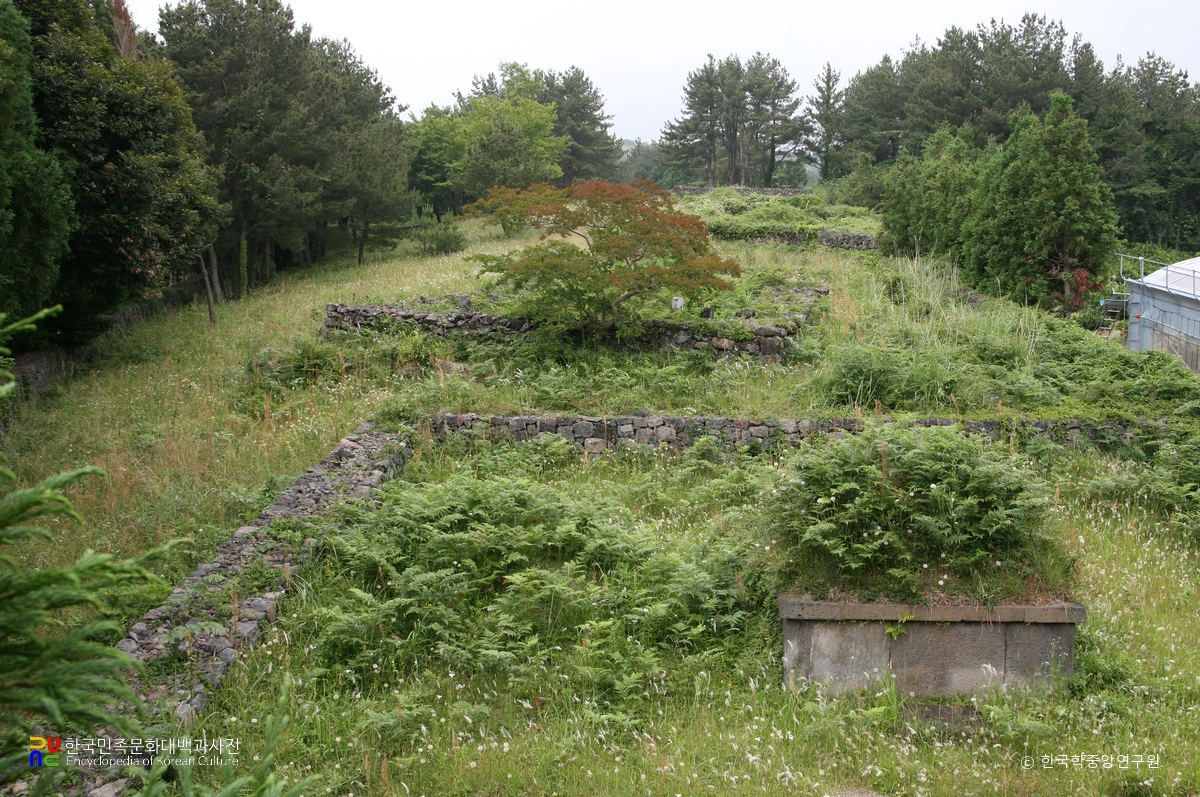
In the Baekpo Bay area of the Haenam Peninsula in South Jeolla Province, identified as the center of Chimmidarye, large-scale archaeological sites have been excavated, illuminating its reality. The Baekpo Bay shell mound (貝塚) site at Gungok-ri, Songji-myeon, Haenam, is confirmed to be an ancient settlement where people lived over a long period from the Neolithic Age to the Three Kingdoms period(kjmbc.co.kr), (kjmbc.co.kr). Here, along a hill 26 m above sea level, a huge shell heap of accumulated shells about 300 m long and 200 m wide, along with traces of dwellings, were discovered(kjmbc.co.kr, kjmbc.co.kr), and it was surveyed to contain a total of 14 cultural layers spanning 5 periods(kjmbc.co.kr). In that life-related features and artifacts from the Bronze Age through the Early Iron Age and the Samhan period are continuously excavated, the Gungok-ri shell mound is evaluated as the only site among the 54 states of the Mahan confederation at which everyday-life artifacts have been confirmed(kjmbc.co.kr). In fact, the excavation revealed, around the shell mound, more than 200 tumuli and dolmens together with dwelling sites constructed in several phases, showing a distinctive pattern in which the life and death of ancient people coexisted in one place(kjmbc.co.kr, kjmbc.co.kr). Researchers interpret this as evidence that the Baekpo Bay power was a stronghold that lasted from the beginning to the end of the Mahan era and a base that formed a core axis of Mahan society(kjmbc.co.kr).
The various artifacts discovered at this site show that the Baekpo Bay power exchanged widely with the surrounding regions and overseas at the time. For example, there is a report that the shell mound yielded not only pottery and ironware of the Korean Peninsula interior lineage, but also some Chinese-style artifacts and fragments of Wa-style pottery from Kyushu in Japan and elsewhere, suggesting that this region was a relay point of international maritime trade1). In particular, the 4th-to-5th-century strata yielded Gaya-style pottery and Wa-style metal goods, supporting the possibility that the Baekpo Bay power traded with Gaya and the Japanese archipelago. Such archaeological material reinforces, with physical evidence, the “independent exchange of Tamna with Gaya and Wa”(dspace.kci.go.kr) seen in the literature. In the end, the Haenam Baekpo Bay site demonstrates that the maritime power running from Chimmidarye (Sinmi State) to Tamna actually existed and bore the character of a city-state that flourished on the basis of maritime trade.
Note: 1) The excavation of trade goods at the Baekpo Bay Gungok-ri site is dealt with in detail in research such as Kang Bong-ryong (2018). However, in this paper, due to space constraints, only the comprehensive significance is described instead of a specific list of artifacts.
2. The Tamna Sites of Jeju Island: Evidence Where Land and Sea Meet
Archaeological discoveries within Jeju Island also prove that Tamna was closely connected with the southern part of the Korean Peninsula. First, in the tumuli and settlement sites excavated in the eastern region of Jeju, regarded as the center of the Kingdom of Tamna, numerous Korean Peninsula-lineage pottery and iron goods have been confirmed. For example, the Songdang-ri tumulus cluster in Jeju yielded **jar coffins (甕棺墓)** and pottery fragments of a style similar to that of the Mahan society of the Yeongsan River basin, which shows that Tamna was strongly influenced by the Mahan-Baekje cultural sphere(dspace.kci.go.kr). In addition, at sites such as the Gosan-ri site in Hangyeong-myeon, Jeju, mainland-origin (陸地産) ring-bells (環鈴) and bronze daggers were excavated, suggesting that there had already been human and material exchange between Jeju and the Korean Peninsula mainland from the Bronze Age through the Early Iron Age2).
One noteworthy piece of archaeological evidence is a case in which artifacts made of Jeju basalt were found in the mainland Haenam region. Basalt is a specialty resource of the volcanic island of Jeju and does not naturally exist in Haenam or the Yeongsan River basin. Yet at southern-coast sites including the Haenam Gungok-ri shell mound, grinding stones (millstones) made of Jeju basalt and net sinkers and the like have been confirmed and reported to academia(m.riss.kr)
. This means that the people of Tamna provided their own island resources as trade goods, and shows that the exchange of goods between Tamna and Chimmidarye was active. Conversely, at the Tamna sites of Jeju Island as well, items made of externally originating materials appear; for instance, some iron weapons and glass beads excavated from Tamna tombs are analyzed as having been produced on the Korean Peninsula mainland (Gaya or Baekje) and transmitted there. Such bidirectional movement of artifacts clearly establishes that the Tamna and Chimmidarye powers had formed economic and cultural ties through the sea.
Note: 2) For cases in which numerous Korean Peninsula-lineage artifacts were excavated on Jeju Island, one may refer to sources such as Kim Byeong-mo’s (1993) survey report on the Tamna sites. That report reveals that the pottery fragments excavated from the Songdang-ri jar coffins belong to the same lineage as Yeongsan-style pottery.
3. Tracing the Trade Routes and Political Influence
The archaeological traces linking Tamna and Chimmidarye can also be grasped through the existence of trade routes. Besides the movement of goods between Haenam and Jeju mentioned earlier, Tamna-related artifacts have been discovered sporadically along the southern coast of South Gyeongsang Province and in the Jeolla Province region. This supports the possibility that maritime trade ships departing from Tamna passed through Gaya as they came and went along the southern coast of the Korean Peninsula. This conjecture also corresponds with the Tamna royal tradition: in the oral records of the Go (高) royal clan of the Kingdom of Tamna, there are stories that *“a Tamna ship on its way to offer tribute to Silla was plundered by the Garak State at Gayapo (伽倻浦)”* or that it was *“seized by the Baekje army at Geomsanpo (劒山浦)”*(ko.wikipedia.org). This tradition shows that Tamna’s tribute ships passed through the coastal strongholds of Gaya and Baekje, and at the same time reveals the circumstance that Baekje and others sought to militarily block Tamna’s external exchange(ko.wikipedia.org). In the end, the southern-sea maritime route that the Tamna-Chimmidarye alliance had controlled came to be recognized as a strategic key point and brought under control amid Baekje’s subsequent expansionist policy.
To summarize, the various pieces of evidence excavated from the Baekpo Bay shell mound site in Haenam and the Tamna sites on Jeju Island demonstrate that Tamna maintained close trade and political solidarity within the Chimmidarye power sphere. The ancient port power of Haenam encompassed even the island regions including Tamna and formed a maritime kingdom, and this suggests that Tamna developed under the protection of the mainland power as a member or vassal state of this alliance. These archaeological results support the relationship seen in the literary sources in a still more concrete manner.
Ⅳ. Conclusion
As a result of the examination of the literary and archaeological materials, the hypothesis that Chimmidarye made Tamna its vassal state has sufficient historical grounds. For 35 centuries, Tamna was under the influence of the Chimmidarye (Sinmi State) maritime alliance of the southwestern Korean Peninsula, and externally it appears to have, in its capacity as a member of the alliance, sent envoys to China and conducted trade with neighboring states(dspace.kci.go.kr, dspace.kci.go.kr). Even after the Chimmidarye mainland power was struck during Baekje’s period of expansion, Tamna survived independently and continued to trade with Gaya, Wa, and others, but in the end, by being subjugated to Baekje’s military and administrative power in the late 5th to early 6th century, it lost its political autonomy(ko.wikipedia.org, jejunews.com). The various traces of exchange confirmed at the Haenam Baekpo Bay shell mound and the Tamna sites of Jeju Island serve as empirical evidence supporting this relationship. In particular, the existence of a maritime trade network connecting Jeju and Haenam makes it clear that Tamna was one axis of the Chimmidarye power sphere.
Of course, there is room for interpretation as to whether Tamna was a completely subordinated colony or an allied body that enjoyed considerable autonomy. In the literature, Tamna had its own king and carried out diplomatic activities, but behind it there was the approval and interference of Chimmidarye or Baekje. Therefore, Tamna’s status may also be seen as an intermediate state between a vassal state and an allied state. Nevertheless, the close relationship of “Chimmidarye-Tamna” itself is what many historical sources and pieces of evidence point to, and through it we can re-illuminate the fact that Jeju Island participated in the historical stage as part of the maritime power of the Korean Peninsula from ancient times.
By highlighting the relationship between Chimmidarye and Tamna that had previously been overlooked, this study has suggested that the history of Tamna can be reinterpreted within the context of the regional history of the southern sea. It is hoped that, through more meticulous archaeological excavation and cross-examination of the Korean, Chinese, and Japanese histories in the future, the reality of the Kingdom of Tamna and its political power dynamics will be revealed still more clearly. In this way, the ancient history of Jeju Island may be established as the history of a maritime kingdom that exchanged on equal terms with the Three Kingdoms.
Notes
【12】 Records related to Tamna (Juho) appearing in the Account of the Eastern Barbarians, Book of Wei, in the 《Records of the Three Kingdoms》. It is recorded that the Juho people differed from the Han in language and customs, and that they came and went by boat to trade goods with Mahan(en.wikipedia.org , en.wikipedia.org). Through this, the circumstance of exchange between Tamna of Jeju Island and Mahan around the 3rd century can be known.
【28】 The record of the entry for the 20th year of King Dongseong (498) in the “Annals of Baekje” of the 《Samguk Sagi》, and the content of the memorial of the Goguryeo envoy Ye Silbul cited in the *《Book of Wei》*. These contain the statement that Tamna (Seopra) was annexed by Baekje and that trade with Goguryeo was cut off, suggesting that in the late 5th century Tamna came into Baekje’s sphere of influence.(ko.wikipedia.org , ko.wikipedia.org).
【15】 The record of the entry for the 2nd year of King Munju (476) in the “Annals of Baekje” of the 《Samguk Sagi》. It conveys the content that, when Tamna offered native products, the Baekje king was pleased and enfeoffed the king of Tamna with the rank of Eunsol(mediajeju.com). This means that during this period Tamna offered tribute to Baekje and was effectively treated as a vassal state.
【44】 Kim Hyeong-hun, “‘Tamna Was Not a Vassal State of Baekje’,” Media Jeju, 2015. The portion of the article that explains the Samguk Sagi records cited therein. It contains explanations regarding Tamna’s offering of local products in the 2nd year of King Munju and the attempted conquest of Tamna in the 20th year of King Dongseong(jejunews.com). In particular, the interpretation that *“Tamna was a tributary state that maintained its relationship by paying tribute taxes, that is, taxes, to Baekje”* is consistent with the present argument.
【51】 Kang Bong-ryong, “The Mode of Existence of the Ancient Port Power of Baekpo Bay in Haenam,” Journal of Baekje Studies (Baekje Hakbo) 26, 2018. Citing the concluding portion that synthesizes the literary and archaeological materials. There is an account that the Sinmi State (Chimmidarye) power emerged in the late 3rd century and led 29 small states in dispatching an envoy to the Jin(dspace.kci.go.kr), reemerged as Chimmidarye in the late 4th century but was subjugated after resisting Baekje(dspace.kci.go.kr), and reappeared as Tamna (Tammora) in the late 5th century, exchanging with Gaya and Wa but coming under attack by Baekje(dspace.kci.go.kr). This is material that well shows the continuity and external relations of Chimmidarye-Tamna.
【32】 Kim Yeong-gwan, “Perspectives on Viewing the Relationship Between Baekje and Tamna,” Studies in Ancient Korean History (Han’guk Godaesa Tamgu) 44, 2023. Referring to the existing differing views introduced in the introduction of that paper(dspace.kci.go.kr). The view that seeks to identify the Chimmidarye of the 49th-year entry of Empress Jingu in the Nihon Shoki with Tamna of Jeju is introduced, but the author (Kim Yeong-gwan) refutes this, holding that it should be regarded as one of the southern-coast Mahan powers such as the Sinmi State. In this paper, significance is placed not on the Nihon Shoki record itself, but on the point that such a name exists in the Japanese records.
【50】 Gwangju MBC report, “The Gungok-ri Shell Mound in Haenam Is a ‘Core Mahan Site’,” 2025. It cites the news content conveying the scale and stratigraphy of the Gungok-ri shell mound and its importance as a Mahan site(kjmbc.co.kr, kjmbc.co.kr). Through this, it can be known that the sites in the Baekpo Bay area of Haenam were the stronghold of a maritime power that lasted for a long period. In particular, the explanation that it is *“the only site among the 54 places of the Mahan confederation at which everyday-life artifacts are excavated”* shows the exceptional importance of the Gungok-ri shell mound(kjmbc.co.kr).
【2】 Jang Chang-eun, “An Examination of the Reality of Tamna in the ‘Annals of Baekje’ of the 《Samguk Sagi》,” Journal of Silla History (Silla Sahakbo) 57, 2023. Through terms such as “Jeju basalt” appearing in the paper’s keywords, it was referenced as an indication that there is research suggesting Jeju Island-origin resources were found at sites in the southern Korean Peninsula(m.riss.kr). The specific cases are as mentioned in Note 1).
【17】 The aforementioned Kim Yeong-gwan (2023) paper. That paper instead argues that Baekje had communicated with Tamna from early on, but in the process it introduces the alternative view that *“the Tamna that sent envoys to Baekje in the 2nd year of King Munju and the 20th year of King Dongseong was not Jeju Island, but Gangjin and Haenam”*(dspace.kci.go.kr). This means that some scholars identify Tamna (Tammora) as a power of the Yeongsan River basin rather than Jeju, which is in line with the hypothesis of this paper.
【28】 The entry for the 13th year of King Munja (503 CE) in the “Annals of Goguryeo” of the 《Samguk Sagi》 and the records of the Yongming era in the 《Book of Wei》. As a passage showing the trade between Goguryeo and Tamna and the circumstances of Baekje’s intervention, it also mentions, together, the Tamna royal tradition that Tamna’s tribute ships were plundered by Gaya and Baekje(ko.wikipedia.org). Through this, it can be known that Tamna built an extensive diplomatic network reaching even Silla to which it sent tribute, and that mainland powers such as Baekje kept this in check.
References: Kang Bong-ryong (2018), Kim Yeong-gwan (2023), Jang Chang-eun (2023), Kim Hyeong-hun (2015, Media Jeju), Gwangju MBC (2025 report), etc.
Leave a comment