Mother-in-Law Conflict in Korean Dramas - Changes Across Eras and an Analysis of Representative Works
Mother-in-Law Conflict in Korean Dramas: Changes Across Eras and an Analysis of Representative Works
In Korean dramas, the conflict between a mother-in-law and a daughter-in-law has taken on various forms as the times changed. In the 1970s and 80s, traditional family relationships and values were reflected, and narratives of sacrifice featuring a strict mother-in-law and an obedient daughter-in-law dominatedstar.ohmynews.com. In the 1990s, along with social change, clashes between an old-generation mother-in-law and a new-generation daughter-in-law began to be depicted comically, while at the same time, more sensational and over-the-top (makjang) mother-in-law conflicts also appeared. Entering the 2000s, the personalities of the mother-in-law and daughter-in-law characters diversified, so that beyond the typical villainous mother-in-law, mother-in-law relationships that reconciled in a humane way also emerged. From the 2010s onward, these changes intensified, and stories in which the daughter-in-law actively stood up to her in-laws or sought solidarity, as well as works that captured the joys and sorrows of realistic mother-in-law conflict, poured out not only over terrestrial broadcasting but also cable and OTT. Looking at the representative dramas that had great social influence in each era, this piece organizes their plots, the patterns of conflict, the social repercussions, and famous scenes.
1970s-80s: The Formation of Traditional Mother-in-Law Conflict and the Authoritarian Mother-in-Law
TBC Assi (The Madam) (1970)
-
Plot overview: Assi, a daily serial that aired in 1970 and drew sensational popularity, portrayed a daughter-in-law, “Assi” (played by actress Kim Ji-mi), who silently endures all kinds of hardships while suffering a harsh life under her in-laws (star.ohmynews.com). At its center is the sacrifice and endurance of the Korean female ideal, who protects her home to the very end despite her mother-in-law’s cruel mistreatment.
-
Development of the mother-in-law conflict: The daughter-in-law is portrayed in the typical mold of one who submits to and sacrifices for her mother-in-law’s oppression. The cause of the conflict is premodern patriarchal authority and the mother-in-law’s contempt for the daughter-in-law, and in the resolution process the daughter-in-law, rather than fighting back, displays the virtue of patient endurance. This setup reflected the real situation of daughters-in-law within the family culture of the time (star.ohmynews.com).
-
Social repercussions and famous scenes: Assi drew empathy across all age groups and earned an explosive response, because the sight of a daughter-in-law battling through hardship against a cruel mother-in-law gave great emotional resonance (star.ohmynews.com). Thanks to this drama’s success, TBC gained the upper hand over KBS and MBC in the daily-serial competition, and afterward similar family dramas poured out (star.ohmynews.com). It was remade in 1997 starring Lee Eung-kyung, making it a work that truly represents its era.
KBS Yeoro (1972)
-
Plot overview: Yeoro is a drama depicting the story of a poor but deeply filial daughter-in-law, Tae Hyun-sil (played by actresses such as Kim Yeong-ae/Jang Mi-hee), who lives while being mistreated by her wicked mother-in-law, played by Park Joo-ah. When it aired in 1972, it was so popular that the term “Yeonggu (永求) Syndrome” was coined (star.ohmynews.com). As the title “Yeoro (女囚, woman prisoner)” suggests, it portrayed the grueling life of the daughter-in-law as if it were a woman’s prison sentence.
-
Development of the mother-in-law conflict: In this drama too, the mother-in-law is a typical villain who cruelly torments the daughter-in-law, while the daughter-in-law obeys with pure devotion and spends her years in tears. To the mother-in-law’s abuse (the cause of the conflict), the daughter-in-law responds consistently with submission and tears, and in the latter half of the drama the conflict is resolved as the mother-in-law belatedly repents at the daughter-in-law’s sincerity and endurance.
-
Social repercussions and famous scenes: Yeoro stirred the tear glands of female viewers and recorded explosive ratings (star.ohmynews.com). The Tae Hyun-sil character became a symbol of the obedient wise mother and good wife, while the mother-in-law character played by Park Joo-ah became the archetype of the wicked mother-in-law figure that would be repeated in many later works. The scenes in which the daughter-in-law is subjugated before her vicious mother-in-law turned living rooms into seas of tears, and afterward KBS also produced the similarly toned family drama Pado (Wave) (1973), which achieved success (star.ohmynews.com).
MBC Saeomma (Stepmother) (1972)
-
Plot overview: Saeomma, an MBC daily serial that aired in 1972, depicted the process by which a young woman (played by actress Jeon Yang-ja) who enters a household as a second wife suffers a harsh life under her in-laws while being treated coldly by her husband’s children, but is ultimately recognized as a member of the family (star.ohmynews.com). An early hit by writer Kim Soo-hyun, it is a work that dealt with the complex family conflicts among the stepmother, the mother-in-law, and the daughter-in-law.
-
Development of the mother-in-law conflict: In Saeomma, the protagonist marries into the family at a young age as a second wife (hutchwi) and is simultaneously scorned by her mother-in-law (played by actress Jeong Hye-seon) and the children. The core of the conflict is the prejudice and mistreatment surrounding “a daughter-in-law not of our own blood,” and the protagonist wins over the family’s hearts through tearful devotion. The mother-in-law, too, is harsh at first but later comes to be moved by the daughter-in-law’s sacrifice. In fact, Jeong Hye-seon, then only 30 years old, brilliantly pulled off the role of a decrepit, aged mother-in-law and was widely praised (star.ohmynews.com).
-
Social repercussions and famous scenes: Saeomma enjoyed high popularity at the time of its broadcast (star.ohmynews.com), and it became a huge talking point by dramatizing the social prejudice against stepmothers, epitomized by the line “no matter how good a daughter-in-law is, not a single drop of blood is shared.” In particular, the mother-in-law character played by Jeong Hye-seon is regarded as the archetype of the harsh-yet-secretly-warmhearted mother-in-law figure that would continue across several of writer Kim Soo-hyun’s later works. Along with the passionate performances of distinguished actors such as Youn Yuh-jung and Jeon Yang-ja, the climactic scene in which the daughter-in-law and mother-in-law reconcile through tears struck a chord with many viewers.
KBS Mabu (The Coachman) (1974)
-
Plot overview: Mabu is a KBS drama that aired in 1974, about a daughter-in-law in the household of a poor coachman (carriage driver) who is tormented by a wicked mother-in-law. The popular veteran actress of the time, Yeo Woon-kay, took on the mother-in-law role and gave a passionate performance.
-
Development of the mother-in-law conflict: The mother-in-law in this drama appears as a snobbish character who fails to understand her daughter-in-law’s situation and does nothing but mistreat her. The daughter-in-law is a sacrificial figure who silently shoulders all the housework and cannot even speak her mind. The conflict continues to the end and is dramatically resolved when, through a family misfortune, the mother-in-law repents of her wrongdoing.
-
Social repercussions and famous scenes: Mabu was a great success when it aired, and above all the sarcastic line “Real nice, what you’re doing” that Yeo Woon-kay spat out in the show left such an impact that it became a catchphrase among viewers (star.ohmynews.com). This line symbolically captures the typical attitude of a mother-in-law who finds fault and sneers no matter what the daughter-in-law does. It is a famous scene that was even parodied in other works later on.
MBC Huhoehamnida (I Regret) (1977)
-
Plot overview: Huhoehamnida, which aired on MBC in 1977, is a drama that, as its title suggests, shed light on the life of a vicious mother-in-law who is left with regret in her later years. Actress Kim Yong-rim drew great attention by vividly portraying that archetype of the wicked mother-in-law (star.ohmynews.com).
-
Development of the mother-in-law conflict: The mother-in-law in this work is portrayed as an absolute ruler who does not treat the daughter-in-law as a human being. The daughter-in-law endures and sacrifices for the family despite the mother-in-law’s abuse, but in the end the conflict is patched up only when the mother-in-law herself grows old and ill and ends up in a position of being cared for by the daughter-in-law. As the title “I Regret” suggests, the mother-in-law repents of her past conduct, but the wounds are already deep, leaving a tragic aftertaste.
-
Social repercussions and famous scenes: Huhoehamnida presented the pinnacle of the authoritarian mother-in-law character and simultaneously drew both anger and tears from viewers (star.ohmynews.com). Scenes such as the one in which the mother-in-law played by Kim Yong-rim treats her daughter-in-law contemptuously and shouts “My word is the law” were famous scenes that maximized the patriarchal family culture of the time. With the mother-in-law character referred to in the style of “the mistress of such-and-such house,” this drama imprinted Kim Yong-rim’s image as the “nation’s mother-in-law” actress well into later years.
MBC 500 Years of Joseon - Seoljungmae (Plum in the Snow) (1984)
-
Plot overview: Entering the 1980s, the theme of mother-in-law conflict began to appear in earnest not only in modern dramas but also in historical dramas (sageuk). The representative example of this is the epic historical drama 500 Years of Joseon - Seoljungmae, broadcast on MBC in 1984 (star.ohmynews.com). Set in the era of King Seongjong of Joseon, this drama dramatized the conflict between Queen Insu (Queen Sohye), Seongjong’s birth mother, of the Han clan, and her daughter-in-law the deposed Queen Yun (Seongjong’s first queen). It made the historical event in which Queen Insu (the mother-in-law) keeps her daughter-in-law Lady Yun in check and ultimately drives her to her death the climax of the drama.
-
Development of the mother-in-law conflict: In Seoljungmae, Queen Insu (played by actress Go Doo-shim) regards her daughter-in-law Lady Yun (played by Lee Gi-seon) as a thorn in her side, in her capacity as a mother-in-law who holds power. The core of the conflict is the envy and jealousy surrounding royal authority and lineage; Queen Insu, mindful even of the future of the grandson (Yeonsangun) borne by the daughter-in-law, tries to eliminate her. In the end, she orders her daughter-in-law to drink poison, leading her to death, and this leads to the later tragedy of the birth of the tyrant Yeonsangun (star.ohmynews.com). Since it was based on a historical event, the resolution was depicted in a tragic and bloody manner.
-
Social repercussions and famous scenes: Seoljungmae proved that even in a historical drama, the power struggle between mother-in-law and daughter-in-law could become a major ratings draw (star.ohmynews.com). The scene in which Queen Insu orders the deposed Queen Yun to drink poison shocked viewers at the time and became a talking point, and afterward the mother-in-law conflict between Queen Insu and the deposed Queen Yun became a popular subject repeated across many historical dramas. For example, different actresses re-enacted the Queen Insu vs. Lady Yun mother-in-law showdown in KBS Hanmyeonghoe (1994), KBS The King and the Queen (1998-99), and JTBC Queen Insu (2011); in particular, in The King and the Queen, Chae Si-ra (Queen Insu) and Kim Sung-ryung (Lady Yun) vividly portrayed a hysterical mother-in-law and an audacious daughter-in-law, winning great love (star.ohmynews.com). Chae Si-ra even won the 1999 KBS Acting Grand Prize for this work, proving the popularity of historical mother-in-law-conflict characters. Meanwhile, the rivalry between Royal Noble Consort Jang (Jang Hui-bin) vs. Queen Myeongseong, which was dramatized several times under the title “Jang Hui-bin,” was also a staple mother-in-law-conflict subject in historical dramas. The vicious karmic bond between mother-in-law and daughter-in-law shown by Kim Hae-sook (Queen Myeongseong) and Jeon In-hwa (Jang Hui-bin) in MBC Queen Inhyeon (1988) continued to be remade in SBS Jang Hui-bin (1995, Gyeon Mi-ri and Jung Sun-kyung), KBS Jang Hui-bin (2002, Kim Yeong-ae and Kim Hye-soo), and so on, drawing the interest of historical-drama fans (star.ohmynews.com).
1990s: Old Generation vs. New Generation - The Daughter-in-Law’s Counterattack and the Coexistence of Makjang Conflict
MBC What Is Love (Saranghi Mwogillae) (1991)
-
Plot overview: What Is Love, which aired in 1991, is a bright and comic family drama depicting the misadventures that unfold when a new-generation daughter-in-law enters a traditional, distinguished household. Centered on the daughter-in-law Park Ji-eun (played by actress Ha Hee-ra) and the mother-in-law Yeo Soon-ja (Kim Hye-ja), this drama unraveled the mother-in-law conflict humorously while setting an astonishing record of a 59.6% average rating.
-
Development of the mother-in-law conflict: In this work, the daughter-in-law Park Ji-eun is, unlike the conventional obedient daughter-in-law figure, a bold character who says everything she wants to say. The cause of the conflict is the difference between the conservative in-law-family culture and the free-spirited daughter-in-law’s values, shown through comic episodes. The mother-in-law Yeo Soon-ja, unlike in the past, is not a figure who wields absolute power but is portrayed as a woman living powerlessly under a patriarchal father-in-law, so that rather than directly confronting the daughter-in-law, she even has moments of joining forces with her to persuade the father-in-law. In the end, the conflicts are resolved one by one through the daughter-in-law’s fresh wit and honesty, and the mother-in-law and daughter-in-law gradually come to understand each other.
-
Social repercussions and famous scenes: What Is Love drew great attention as a groundbreaking attempt that completely overturned the previously uniform daughter-in-law figure. The character of “a daughter-in-law who speaks her mind rather than merely reading her mother-in-law’s mood” was a fresh shock, and Kim Hye-ja won the MBC Acting Grand Prize for this work, becoming beloved as the nation’s mother-in-law. In particular, scenes in which Ha Hee-ra grumbles because she cannot adapt to the military-style family customs of her in-laws, or flusters her mother-in-law by speaking frank truths to her, were popular as famous comic scenes. From this drama as a turning point, the image of the mother-in-law and daughter-in-law in Korean dramas changed greatly, becoming the catalyst for various mother-in-law-and-daughter-in-law characters to appear thereafter.
SBS Winter Bird (Gyeoulsae) (1992)
-
Plot overview: Winter Bird is a much-talked-about work that recorded an exceptional peak rating of 48.2% despite airing as a morning drama on SBS in 1992. It depicted the desperate conflict between a two-faced mother-in-law (played by actress Ban Hyo-jung) who is cultured on the outside but cares only about money on the inside, and the daughter-in-law (Kim Do-yeon) who is abused under her. As the title suggests, it symbolically captured the plight of a daughter-in-law who is like a bird left alone in the cold winter.
-
Development of the mother-in-law conflict: In the drama, the mother-in-law (played by Ban Hyo-jung) is a two-faced villainess who pretends to be kind in front of others but is merciless toward the daughter-in-law. The cause of the conflict is the mother-in-law’s greed, which prizes only economic gain and appearances, and the daughter-in-law suffers mistreatment and verbal abuse for no reason. Even when the daughter-in-law becomes pregnant or contributes to the household, the mother-in-law is jealous and disparaging, amplifying the conflict. Finally, when the daughter-in-law tries to abandon everything and leave, the conflict concludes with the mother-in-law collapsing in guilt only then.
-
Social repercussions and famous scenes: Winter Bird became a nationwide talking point, breaking the conventional belief that “only housewives watch morning dramas.” The snobbish mother-in-law character played by Ban Hyo-jung was evaluated as so realistic it was eerie, and her cold expression and the line “money is everything” earned the public’s indignation. By contrast, the tearful performance of Kim Do-yeon as the daughter-in-law evoked great sympathy. In particular, the shocking scene in which the mother-in-law shoves away the grandson strapped to the daughter-in-law’s back is a famous scene over which protests flooded the viewer message boards after broadcast. (This work was remade 15 years later, in 2007, as an MBC weekend drama, and in the remake Park Won-sook took on the mother-in-law role, drawing praise for a portrayal of two-faced madness that was somewhat more comic than the original yet still wild.)
KBS The Men of the Bathhouse (Mokyoktangjip Namjadeul) (1995)
-
Plot overview: The Men of the Bathhouse was a major hit that aired as a KBS weekend serial in 1995 and triggered a nationwide bathhouse syndrome. Set in a household with four brothers, it cheerfully depicted the conflict between the youngest daughter-in-law Kim Soo-gyeong (played by actress Kim Hee-sun) and the old-generation authoritarian mother-in-law (Jeong Yeong-suk). It blended generational differences and mother-in-law conflict into everyday episodes centered on a family-run bathhouse.
-
Development of the mother-in-law conflict: The youngest daughter-in-law Soo-gyeong is the epitome of the Generation X of the time - a daughter-in-law who does not meekly do as she is told but says everything she has to say. The mother-in-law, with her strong traditional notions, finds the daughter-in-law’s behavior displeasing and clashes with her. As a representative conflict scene, when the mother-in-law scolds her, Soo-gyeong frequently looks her straight in the eye and retorts, “That’s your opinion, Mother, and my opinion is different.” This is a passage that plainly shows that the cause of the conflict is a difference in thinking between generations, with the daughter-in-law refusing to back down from her own assertions and standing her ground logically to the end. In the end, the mother-in-law and daughter-in-law each yield and come to understand each other little by little, leading to a heartwarming conclusion of mutual adaptation.
-
Social repercussions and famous scenes: At the time, the Soo-gyeong character played by Kim Hee-sun drew great attention as “a new-generation daughter-in-law who is not intimidated by the existing parental generation,” winning support from the younger crowd while coming as a shock to the older generation. When the scene of her clearly talking back to her mother-in-law with “my opinion is different” aired, a generational debate even broke out among viewers. While some elders reacted with “how impudent,” many young daughters-in-law cheered, saying “how refreshing,” and the line became a big catchphrase. This very back-and-forth dispute was itself a social repercussion reflecting the changing times. This drama was also evaluated as a masterpiece of family comedy, with theme-song covers and parodies pouring out at the time, and it even gave rise to catchphrases like “Be nice to Soogi (Soo-gyeong)~.”
SBS Let Me Show You a Taste (Maseul Boyeodeurimnida) (1999)
-
Plot overview: Let Me Show You a Taste, which aired in 1999, was an SBS weekend drama that performed well while competing in the same time slot against the megahit historical drama Heo Jun. It depicted the lighthearted war of nerves between a newly married bride, Ji-won (played by actress Kang Sung-yeon), and her traditional mother-in-law (Jeong Yeong-suk), centered on cooking and housekeeping. As the title suggests, its characteristic feature is a mother-in-law-versus-daughter-in-law battle of wills waged over cooking contests.
-
Development of the mother-in-law conflict: The daughter-in-law Ji-won has a frank and bold personality befitting her generation, while the mother-in-law is the typical Korean-mother figure who dotes terribly on her son. The conflict is mainly expressed through differences in housekeeping methods and tastes. For example, when the daughter-in-law makes Western or new dishes, the mother-in-law nitpicks, saying “this isn’t how our family’s food is done,” and conversely, when the mother-in-law forces traditional methods, the daughter-in-law sticks to her own way and they clash. Neither side budges an inch, so the conflict grows, but each episode proceeded in a pattern of small reconciliations mediated by food.
-
Social repercussions and famous scenes: The secret to this drama’s popularity was the arch-rival chemistry between Kang Sung-yeon and Jeong Yeong-suk. The comic tension of their bickering scenes - for example, lines like “she’s ruined the daughter-in-law’s palate” vs. “Mother, you ought to keep up with the trends too” - gave great laughs. Ratings were lower than the competing work, but it performed well, steadily maintaining double digits, and in particular a debate over realism arose, with views like “the daughter-in-law talks back to the mother-in-law too much” vs. “there really are daughters-in-law like that.” Although some criticized the setup as unrealistic, the mother-in-law-and-daughter-in-law battle of wills was a talking point right up to the final episode, and the work is remembered as an example that showed the changed mother-in-law-and-daughter-in-law image of the late 1990s.
KBS Legend of the Hometown (Jeonseolui Gohyang) - The Gate of the Virtuous Woman (Yeollyeomun) (1999)
-
Plot overview: Legend of the Hometown was KBS’s horror anthology series, and the 1999 episode “The Gate of the Virtuous Woman” was the story that caused the greatest stir that year. The content is a Korean-style horror story about a heartless mother-in-law who sacrifices her daughter-in-law in order to obtain a yeollyeomun (a gate erected for a virtuous woman who keeps her chastity), and the daughter-in-law who becomes a vengeful spirit and takes revenge. It is a distinctive case of unraveling mother-in-law conflict in the form of a ghost story.
-
Development of the mother-in-law conflict: Set in the Joseon era, there is a daughter-in-law who has become a young widow, and the mother-in-law becomes obsessed by the notion that if the daughter-in-law does not remarry and keeps her chastity for her whole life, a yeollyeomun will be bestowed upon the family. The cause of the conflict is the mother-in-law’s misguided desire for honor; not content with the daughter-in-law spending her youth alone, she even devises a plan to murder the daughter-in-law outright and forcibly make her a virtuous woman. In the end, the mother-in-law poisons the daughter-in-law to death and receives the yeollyeomun, but the daughter-in-law returns as a vengeful spirit and takes revenge by tormenting the mother-in-law and the household. Throughout the story, the mother-in-law’s greed and wickedness are maximized within a horror atmosphere.
-
Social repercussions and famous scenes: “The Gate of the Virtuous Woman” episode became a huge talking point after broadcast and became the driving force behind the revival of Legend of the Hometown. In particular, the mother-in-law figure played by Ban Hyo-jung was so eerie that she was described as “a human scarier than any ghost,” and the scene in which she, with a cold expression, offered the daughter-in-law a poisoned meal table was counted as a spine-chilling famous scene. Also, the final scene in which the daughter-in-law’s ghost weeps tears of blood before the yeollyeomun is remembered as the highlight that expressed the just deserts of mother-in-law conflict in the horror genre. Viewers found this distinctive approach to unraveling mother-in-law conflict fresh, and “The Gate of the Virtuous Woman” powerfully conveyed the message that, across all times and places, the daughter-in-law-and-mother-in-law problem continues.
2000s: The Two Faces of Makjang and Reconciliation - The Diversified Mother-in-Law Narrative
SBS Flame (Bulkkot) (2000)
-
Plot overview: Flame is a drama broadcast on SBS in early 2000, a work that depicted the suffocating conflict between a chaebol-family mother-in-law and a daughter-in-law from an ordinary household. Actress Kang Boo-ja played a chilly mother-in-law who subdues the daughter-in-law with nothing but her gaze, without saying a word, and Lee Young-ae appeared as that daughter-in-law. On the surface it flows along without major incident, but its characteristic feature is the eerie portrayal of the extreme tension the daughter-in-law feels in her in-laws’ home.
-
Development of the mother-in-law conflict: In this drama, the mother-in-law (played by Kang Boo-ja) does not overtly mistreat the daughter-in-law, but her very existence is a source of pressure. The daughter-in-law (played by Lee Young-ae), in a situation where she lives a perfunctory life with her husband without affection, becomes daily more cowed as she endures even the mother-in-law’s grim surveillance and interference. The core of the conflict is the mother-in-law’s subtle displays of disregard and disgust, and the daughter-in-law is simply crushed by that force, unable even to rebel. In one scene, while the daughter-in-law is pouring out her heart and swallowing her tears on a phone call with a friend (Jang Seo-hee), the mother-in-law suddenly appears behind her, startling everyone. With such direction, the terror of life with her in-laws is maximized, expressing the conflict. In the end, the daughter-in-law makes an extreme choice (running away from home), and the drama concludes with an ending in which the mother-in-law only then realizes her own coldness.
-
Social repercussions and famous scenes: Critics evaluated the in-law household scenery in Flame as “almost horror-level.” Indeed, in the scene where Lee Young-ae sobs during the phone call and the mother-in-law Kang Boo-ja abruptly appears, many viewers testified that a chill ran down their spines. The scene in which Kang Boo-ja sits at the dining table scanning the daughter-in-law with an expressionless face, and the scene in which the daughter-in-law freezes up holding the phone, are counted among the famous scenes of Flame. This work gave a fresh shock by portraying the horror of the in-law world even without overt verbal abuse, and it even prompted the saying, “From the daughter-in-law’s perspective, the in-laws’ home is a horror movie.”
KBS The Golden Age of Daughters-in-Law (Myeoneuri Jeonseongsidae) (2007)
-
Plot overview: The Golden Age of Daughters-in-Law was a KBS weekend serial broadcast in 2007 that, as its title suggests, put forward the catchphrase “This is now the golden age of bad daughters-in-law” and unraveled mother-in-law conflict comically as a family drama. It depicted the conflict and reconciliation between the daughter-in-law Oh Yeong-sim (played by actress Lee Soo-kyung), who is not intimidated by her in-law family, and the stubborn mother-in-law (Kim Bo-yeon) who is not fond of her. It drew popularity with high ratings approaching 30%, and was praised for its bright atmosphere like a family sitcom.
-
Development of the mother-in-law conflict: The daughter-in-law Yeong-sim in this drama has a tenacious and sharp personality, and habitually gives refreshing comebacks to her in-laws’ unreasonable demands. The conflict mainly begins from the mother-in-law’s interference and old-generation notions; for example, when she tries to make the daughter-in-law take sole charge of ancestral-rite preparations and housework, Yeong-sim retorts, “The era when the daughter-in-law did it all alone is over.” In this way, situations are repeated in which the daughter-in-law says everything she has to say and the mother-in-law flares up. However, the conflict is not dragged out into something serious, but is eased here and there with humor and incidents, and it ultimately leads to a reconciliatory ending in which they come to understand and acknowledge each other.
-
Social repercussions and famous scenes: The Golden Age of Daughters-in-Law gained great popularity by wittily satirizing mother-in-law conflict. In particular, by presenting not the oppressed daughter-in-law of existing dramas but a figure of a daughter-in-law who struggles hard and stands as a confident member of the family, it won the ardent support of young female viewers. The scenes in which Lee Soo-kyung speaks her mind before the in-law elders are remembered as gratifying famous scenes. For example, when the mother-in-law says “the daughter-in-law should endure a bit for the household to be at peace,” the passage in which Yeong-sim spiritedly retorts, “A peace that depends on one person’s sacrifice is a fake peace,” brought catharsis to viewers. In this way, this drama, by declaring that the daughter-in-law was no longer the underdog but a confident member of the family, symbolized the change in the 2000s mother-in-law narrative.
(Mothers-in-Law in Makjang Dramas)
-
Plot overview: Meanwhile, in the mid-to-late 2000s, as ratings competition intensified, mother-in-law characters also appeared powerfully in sensational makjang dramas. Representative examples include the mother-in-law in SBS The Club of Faithful Wives (Jogangji Cheo Keulleop) (2007) (played by actress Kim Hae-sook), the mother-in-law in the KBS daily serial You Are My Destiny (Neoneun Nae Unmyeong) (2008) (Yang Geum-seok), the mother-in-law role played by Geum Bo-ra in SBS Temptation of Wife (Anaeui Yuhok) (2008-09), and the mother-in-law in MBC Shining Inheritance (Banjjak Banjjak Binnaneun) (2011) (Kim Ji-young).
-
Development of the mother-in-law conflict: In these works, the mothers-in-law are consistently portrayed with personalities so harsh they verge on cruel. They work the daughter-in-law like a slave or hatch cunning schemes to drive her out of the house, with the intensity of the conflict even exceeding any sense of realism. For instance, in Temptation of Wife, the mother-in-law played by Geum Bo-ra tries, without guilt, to accept her son’s affair partner as a new daughter-in-law even after the daughter-in-law has died, and the Kim Hae-sook character in The Club of Faithful Wives does not even treat the daughter-in-law as a person and plots to make her divorce her son. With such extreme setups, the conflict is maximized, and there were many developments in which, at the climax, the mother-in-law is punished (the daughter-in-law’s revenge) or meets an extreme end.
-
Social repercussions and famous scenes: The wicked mothers-in-law of makjang dramas were beings who provoked anger by stimulating viewers’ raw nerves, yet strangely made it impossible to look away. For this reason, on one hand there was strong critical public opinion that “they mass-produce sensational mother-in-law conflict,” but those dramas all racked up high buzz and ratings. For example, the scene in You Are My Destiny where the mother-in-law traps the daughter-in-law (played by Yoona) and slaps her face, and the scene in Temptation of Wife where the mother-in-law splashes water on the daughter-in-law while screaming “you ungrateful wench who abandoned my son,” gave rise to countless parodies online. In this way, the mothers-in-law in makjang dramas, by unraveling traditional mother-in-law conflict through an exaggerated makjang code, became one element of 2000s popular culture.
(Mother-in-Law Dramas of Reconciliation and Understanding)
-
Plot overview: In contrast to sensational conflict, the 2000s also saw the appearance of many works that depicted the conflict and reconciliation between mother-in-law and daughter-in-law in a humane way. Examples include KBS Mom Has Grown Horns (Eommaga Ppulnatda) (2008), SBS Life Is Beautiful (Insaengeun Areumdawo) (2010), KBS The Brothers of Ojakgyo (Ojakgyo Hyeongjedeul) (2011), KBS My Daughter Seo-yeong (Nae Ttal Seo-yeong-i) (2012), and JTBC Childless Comfort (Mujasik Sangpalja) (2012). In these works, the mother-in-law and daughter-in-law are portrayed not merely in an opposing relationship but in a companionable relationship in which they understand each other and grow together.
-
Development of the mother-in-law conflict: In these dramas, conflict is not entirely absent, but they mainly deal realistically with small misunderstandings or frictions arising from generational differences, and show them being resolved through dialogue and consideration. The mother-in-law, too, is by no means an absolute villain but sometimes appears as the weaker party, or even as a figure who has something to learn from the daughter-in-law. For example, in Mom Has Grown Horns, Kim Hye-ja in the mother-in-law role rather learns much from the daughter-in-law (Shin Eun-kyung) and ultimately comes to be like friends with her, and in Childless Comfort, there is a scene in which the daughter-in-law (Eom Ji-won) and the mother-in-law (Park Won-sook) understand each other
as womenand shed tears. The cause of the conflict is mostly set as a difference in values between generations, and the resolution comes through empathy and love for each other. -
Social repercussions and famous scenes: These heartwarming mother-in-law dramas gave emotion and hope to viewers weary of makjang, and received much love. Scenes such as the one in My Daughter Seo-yeong where the daughter-in-law Seo-yeong (Lee Bo-young) and the mother-in-law clear up their misunderstanding and embrace, weeping, and the one in Life Is Beautiful where the mother-in-law Kim Yeong-ae tells the daughter-in-law Jang Seo-hee, “You’re like a daughter to me,” her eyes reddening, were praised by viewers. Also, the ending of Childless Comfort, in which the whole family gathers and apologizes to and forgives one another, beautifully depicted reconciliation across generations and drew applause. In this way, the dramas of the late 2000s reflected the changing times and began to show that the mother-in-law, too, is not an unyielding authority figure but a human being who wishes to be understood.
MBC Royal Family (2011)
-
Plot overview: Royal Family is a drama broadcast on MBC in 2011, a work that blended a vicious mother-in-law conflict into a crime-of-passion mystery set against a chaebol family. Kim Yeong-ae played Gong Sun-ho, the cold-hearted mother-in-law of the chaebol family, and Yum Jung-ah played the daughter-in-law Kim In-sook. Its characteristic feature is a tense development in which a hidden murder case and power struggle unfold between the mother-in-law who holds the family’s power and the daughter-in-law of lowly origins.
-
Development of the mother-in-law conflict: In the drama, the mother-in-law Gong Sun-ho is an icy figure who does not even treat the daughter-in-law as a person. The cause of the conflict is the mother-in-law’s discrimination and hostility, as she finds the daughter-in-law’s background displeasing. When calling the daughter-in-law In-sook, Gong Sun-ho refers to her as “that thing” instead of by name, and even in front of the daughter-in-law commands “Get that thing out of here,” showing that she does not treat the daughter-in-law as a human being. The daughter-in-law In-sook holds out for her son’s future even amid the mother-in-law’s chilling oppression, but in the end she is placed in a life-threatening crisis by the mother-in-law’s schemes. The conflict escalates to an extreme, with the mother-in-law indirectly causing even the daughter-in-law’s death, and it concludes in a form where, at the climax, this fact is revealed and the mother-in-law is punished.
-
Social repercussions and famous scenes: Gong Sun-ho, played by Kim Yeong-ae, was such a fearsome character that she was hailed as a new milestone for the vicious mother-in-law. In particular, the line “Get that thing out of here” became a huge talking point at the time the drama aired, generating all kinds of parodies and memes, and it is still invariably brought up whenever the makjang mother-in-law character is discussed. The scene where this line appears - the sequence in which she points at the daughter-in-law seated together at the dining table and tells the servants to “get that thing out of here,” as if driving her away - is counted as an eerie famous scene. Royal Family was highly popular overall thanks to its suffocating development together with Kim Yeong-ae’s chilling performance, and it was evaluated as having immersed viewers to the very end with the subject of a chaebol-family mother-in-law conflict, sensational as it was.
2010s: Reilluminating the Real Mother-in-Law Conflict and the Daughter-in-Law’s Solidarity
KBS Unexpected You (Neongkulijae Gulleoon Dangsin) (2012)
-
Plot overview: In Unexpected You (counted, along with My Daughter Seo-yeong, as one of the most talked-about works of 2012, a KBS weekend serial), the conflict and solidarity between the daughter-in-law Cha Yoon-hee, played by Kim Nam-joo, and the mother-in-law Bang Mal-suk (Youn Yuh-jung) were vividly depicted. Cha Yoon-hee is a “windfall rolled in” daughter-in-law who visits her in-laws by chance, and the drama cheerfully shows the process of her becoming family while clashing with the in-law household. This drama recorded ratings approaching 45% and won nationwide love.
-
Development of the mother-in-law conflict: In the drama, Cha Yoon-hee is a proud, new-generation daughter-in-law who is a career woman, while Bang Mal-suk appears as a humane mother-in-law who is snobbish yet bumbling. The conflict mainly begins from minor differences in lifestyle habits or the issue of dividing housework, and the daughter-in-law Yoon-hee is a character who never endures injustice but stands up to it. For example, when a conflict arises over ancestral-rite preparations, Yoon-hee declares, “There’s no rule that the working daughter-in-law has to do it all alone,” and Bang Mal-suk grumbles but ultimately comes around little by little to the daughter-in-law’s reasonable argument. Also, when the in-laws’ interference is severe, Yoon-hee firmly draws boundaries together with her husband, and for the parts where she is in the wrong, she apologizes to her mother-in-law first, attempting honest communication. Through this process, the mother-in-law and daughter-in-law both grow and grow closer.
-
Social repercussions and famous scenes: Kim Nam-joo’s Cha Yoon-hee character even gave birth to the neologism “Si-world (in-law world),” which became a catchphrase at the time. “Si-world” is an expression likening life with one’s in-laws to a world of its own, and the various episodes Yoon-hee experiences with her in-laws in the drama were said to be realistic, winning a storm of empathy from the young daughter-in-law demographic. Female viewers cheered at every single line of Yoon-hee’s, and Kim Nam-joo won the KBS Acting Grand Prize for this drama, marking the peak of her career. Meanwhile, the Bang Mal-suk mother-in-law character played by Youn Yuh-jung was also praised for a portrayal that was suitably humane yet worldly. One of the famous scenes of this drama is the one in which Yoon-hee opens up to her mother-in-law for the first time and weeps. Here, when Yoon-hee says, “If you treat me like a mother would, I’ll be as good to you as a daughter,” the scene of Bang Mal-suk shedding tears and embracing the daughter-in-law moved many viewers. In this way, Unexpected You warmly depicted a new-generation daughter-in-law and an old-generation mother-in-law restoring their relationship through honest dialogue, giving great emotion and laughter.
JTBC The Avengers Social Club (Buamdong Boksujadeul) (2017)
-
Plot overview: The Avengers Social Club is a drama broadcast on the cable channel JTBC in 2017 that earned a fresh response and presented a new way of resolving mother-in-law conflict. It is the story that unfolds when the chaebol-family daughter-in-law Kim Jung-hye (played by Lee Yo-won) forms a secret revenge alliance together with two other women in order to take revenge on the mother-in-law who has ignored and tormented her. Unlike the existing image of a daughter-in-law who endures or sheds tears, the setup in which the daughter-in-law proactively stands up to the mother-in-law was groundbreaking.
-
Development of the mother-in-law conflict: Kim Jung-hye is a character who appears weak on the surface but has accumulated anger within, and the mother-in-law (played by Choi Myung-gil) is a typical chaebol-household matriarch who looks down on the daughter-in-law and even condones her husband’s affair, driving the daughter-in-law into a corner. With her conflict erupting, Kim Jung-hye ultimately joins forces with two other women who each have their own stories (played by Myung Se-bin and Ra Mi-ran) to plan a covert revenge. Their method of revenge is not violence but exposing the mother-in-law’s weaknesses and subjugating her psychologically - for example, catching evidence of the mother-in-law’s illegal corruption and making it public to shame her, or tearing down the social reputation she treasures most. In the process, Kim Jung-hye gains courage and grows through solidarity with her allies. In the end, the mother-in-law pays the deserved price for the things she has done, and Kim Jung-hye leaves her in-laws and becomes independent.
-
Social repercussions and famous scenes: The Avengers Social Club drew attention as a feminist drama at the time of its broadcast. The very setup in which the daughter-in-law takes direct action to clear her own grievances was gratifying. In particular, the scene in which Kim Jung-hye, no longer bowing her head before the mother-in-law, gives a smile of counterattack and declares, “From now on, I’ll handle my own life,” drew loud cheers. Also, the other daughter-in-law character played by Myung Se-bin devotedly cares for her mother-in-law, who has dementia, to the very end, and sobs after the mother-in-law passes away, thereby also illuminating a mother-in-law-and-daughter-in-law relationship like mother and daughter (blog.naver.com). This was a case that dealt with both a bad mother-in-law and a good mother-in-law within the same drama, capturing the spectrum of the mother-in-law-and-daughter-in-law relationship. Although this work’s ratings were moderate, it is evaluated as a meaningful attempt in that it presented a new imagination for resolving mother-in-law conflict.
JTBC SKY Castle (2018)
-
Plot overview: SKY Castle, which aired on JTBC in 2018 and caused a social syndrome, is a drama depicting upper-class families consumed by the competition over college admissions. Although the story is mainly centered on the mothers, in its backdrop lie deep-rooted mother-in-law conflict and patriarchal expectations. In particular, through the character of Han Seo-jin (played by Yum Jung-ah), the relationship between a conservative mother-in-law and a daughter-in-law is revealed. In the drama, Han Seo-jin is a chaebol-family daughter-in-law who appears perfect, but she married having hidden her past status, and her mother-in-law, Madam Yoon (played by Jung Ae-ri), is a figure who looks down on and pressures such a daughter-in-law.
-
Development of the mother-in-law conflict: Han Seo-jin is gripped by an obsession with getting her daughters into prestigious universities, which, it turns out, is due to her mother-in-law’s handed-down coercion. Madam Yoon wanted a grandson to carry on the family line, but when the daughter-in-law bore only two daughters, she harbored discontent, and she is a figure who wants the daughter-in-law to make the children top elites by whatever means necessary. In the drama, Madam Yoon pressures the daughter-in-law Seo-jin, saying “you must not bring a blemish to our family,” and Seo-jin, in order to be acknowledged by her mother-in-law, even resorts to the reckless measure of spending billions of won to hire an admissions coordinator (kookje.co.kr). One of the scenes where the conflict reaches its height is the one in which Seo-jin drops to both knees before her mother-in-law and endures the humiliation, vowing “I will definitely get Ye-seo (her daughter) into Seoul National University’s medical school” (kookje.co.kr). In the end, in trying to live up to her mother-in-law’s coercion and expectations, Seo-jin drives her own life and family to the brink of ruin, and belatedly realizes her mistake. In the conclusion, the mother-in-law too lets go of her obsession with a grandson and attempts reconciliation with the daughter-in-law, but the wounds are already left deep.
-
Social repercussions and famous scenes: Although the main content of SKY Castle was educational competition, the fact that there was an invisible mother-in-law conflict behind it also became a topic of conversation for many viewers. The scene in which Yum Jung-ah tearfully pleads and kneels before her mother-in-law, played by Jung Ae-ri, was counted as a showstopper, and captures and lines from that scene spread online, drawing reactions like “the tragedy of a modern-day mother-in-law conflict.” Also, scenes in the latter part of the drama, such as the one in which, when Han Seo-jin’s past status is revealed, the mother-in-law Madam Yoon rages and tries to drive the daughter-in-law out, re-enacted the figure of the traditional status-discriminating mother-in-law and drew viewers’ indignation. SKY Castle, in dealing with the family image of Korea’s upper class, was praised for pointing out that the more perfect a household appears on the outside, the more the daughter-in-law sacrifices unseen. As much as its high buzz, there were also many parodies, and actress Jung Ae-ri came to be perceived for a while as “the representative mother-in-law of South Korea” because of this drama.
2020s and Beyond: A New Generation’s Mother-in-Law Discourse - The Age of Realistic Exposé and Empathy
Kakao TV My Bossy Mother-in-Law (Myeoneuragi) (2020-2021)
-
Plot overview: Myeoneuragi is a web drama released on Kakao TV (an OTT platform) from late 2020 through early 2021, based on the popular webtoon of the same name. It depicted the realistic in-law-world experience of Min Sa-rin (played by Park Ha-sun), a rookie daughter-in-law who enters in-law-family culture at the same time as marriage. Even without any particular villain, it minutely portrayed how difficult real-life mother-in-law conflict is, winning great empathy. On the strength of Season 1’s success, a Season 2 was also produced in 2022.
-
Development of the mother-in-law conflict: Min Sa-rin was an ordinary office worker, but once she becomes a daughter-in-law after marriage, her daily life changes 180 degrees. The mother-in-law Park Gi-dong (played by Moon Hee-kyung) seems prim and kind, but subtly expects a lot from the daughter-in-law. The conflict begins from small things. Setting the table for the in-laws’ birthdays, preparing holiday food, looking after the husband - all become the daughter-in-law’s job, and the husband, thinking “you should be good to my mom and dad,” demands it of the daughter-in-law as if it were only natural. Sa-rin, even while feeling it is unreasonable, lives with “I’ll do it, I’ll do it” on her lips, patiently conforming to her in-laws (star.ohmynews.com). When she goes to her in-laws’ home, she takes sole charge of the dishes, and, like an outsider unable to join the conversation, she only does the cleanup (star.ohmynews.com). The husband fails to grasp such a wife’s feelings, and the mother-in-law does not even notice that the daughter-in-law is struggling. Decisively, the conflict erupts over the issue of the husband’s overseas business trip early in their newlywed life. When Sa-rin tries to take care of her in-laws’ wedding anniversary, the mother-in-law chides her, saying “are you going to starve your husband as a newlywed and go on a trip?” (star.ohmynews.com), and Sa-rin is deeply wounded. The essence of the conflict is the one-sided sacrifice demanded only of the daughter-in-law, and at the end of Season 1, Sa-rin, after enduring and enduring, lets out her aggrieved feelings for the first time. Through this process, the husband and the in-laws too come to accept change little by little.
-
Social repercussions and famous scenes: Myeoneuragi was described as a drama so realistic it is sad (star.ohmynews.com). In fact, ever since the original webtoon was serialized in 2017, it had drawn explosive empathy on social media with comments like “this is my story,” and the drama too became a talking point after release, recording over a million views per episode (star.ohmynews.com). The work’s fervent response ultimately stemmed from its real-life resonance, as many married women actively shared the story, saying “Myeoneuragi is reality for someone.” The famous scenes, too, came not from grand events but from daily life. For example, the scene in which Sa-rin, who has prepared seaweed soup and japchae from dawn for her mother-in-law’s birthday table, fails to fit in among the in-law family and drifts about awkwardly, feeling deflated (star.ohmynews.com), left viewers with a heavy heart. Also, while Sa-rin remains alone doing the dishes, the in-law family watch TV and laugh and chatter, and the mother-in-law stuffs leftover fruit into the daughter-in-law’s mouth, saying “it’s a waste to leave it, let’s clear this up” (star.ohmynews.com) - the sense of estrangement and hurt Sa-rin feels at this moment was conveyed intact through the screen, and many viewers grew angry along with her. Myeoneuragi, by meticulously portraying the joys and sorrows of real-life in-law living even without sensational events, left the significance of having brought to the surface the unjust burdens still imposed on daughters-in-law in Korean society. This awakened the simple truth that “the daughter-in-law is a person too,” and after the broadcast, hashtag movements such as “Let’s check our own household’s Myeoneuragi” and “Let’s not force the good-daughter-in-law role” even arose online.
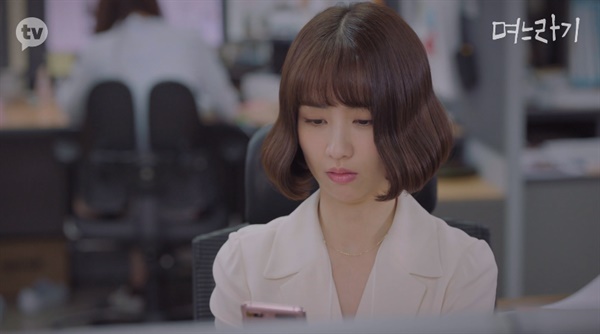
Figure 1: A scene of the realistic in-law world in Myeoneuragi. The working woman Min Sa-rin (played by Park Ha-sun) is being saddled with preparing the mother-in-law’s birthday via a message from her sister-in-law (star.ohmynews.com, star.ohmynews.com). This scene, in which she boils seaweed soup from dawn yet feels alienated herself, shows the absurdity of the “proxy filial piety” taken for granted as the daughter-in-law’s duty after marriage. The drama’s delicate exposé of reality evoked the empathy of many daughters-in-law.
tvN Mine (2021)
-
Plot overview: Mine is a drama released through tvN and Netflix in 2021, a mystery melodrama that dealt with the secrets and conflicts of a chaebol family. In this work too, mother-in-law conflict appears as an important axis, with the events that unfold as the chaebol-family mother-in-law Yang Chun-ok (played by Park Won-sook) controls her two daughters-in-law, Seo Hi-soo (Lee Bo-young) and Jung Seo-hyun (Kim Seo-hyung). While dealing with the corruption and murder hidden behind a splendid exterior, at its foundation lies the tension between mother-in-law and daughter-in-law within a patriarchal power structure.
-
Development of the mother-in-law conflict: In Mine, the mother-in-law Yang Chun-ok is the absolute power-holder of the family. The elder daughter-in-law Seo Hi-soo is a former actress who pretends to be bright and obedient, but struggles under the mother-in-law’s discrimination. The younger daughter-in-law Jung Seo-hyun is a figure who married in as the daughter of another chaebol family, but has lived hiding her own desires so as not to fall out of the mother-in-law’s good graces. The cause of the conflict is that the mother-in-law prizes only the family’s pure bloodline and honor and tries to manipulate the daughters-in-law to her own will. For example, the mother-in-law has known that the grandson is in fact not Hi-soo’s biological child yet has hidden it for the sake of the family’s face, and even after Hi-soo learns this fact, she threatens the daughter-in-law and forces her to keep her mouth shut. She also notices that the younger daughter-in-law Seo-hyun’s past lover was a woman (a lesbian) and uses this as leverage to bind the daughter-in-law. The daughters-in-law seem to submit to the mother-in-law’s pressure, but behind the scenes each seeks a way to escape her. In the end, in the latter part of the drama, when the mother-in-law urges them to cover up the family’s crime, the two daughters-in-law join forces to stop it and pull the mother-in-law down from her throne.
-
Social repercussions and famous scenes: Mine performed respectably with ratings of around 10% at the time of its broadcast, and drew attention for the solidarity of strong female characters. In particular, the scene in which the two daughters-in-law join forces to expose the mother-in-law’s wrongdoings and declare “now we will reclaim what is ours” was praised as a refreshing famous scene. Also, the scene in which the mother-in-law Yang Chun-ok tries to slap the daughter-in-law Hi-soo but the daughter-in-law grabs her wrist and stops her, and the subsequent scene in which Hi-soo pours out everything she has to say to the mother-in-law for the first time, became talking points as impressive mother-in-law-versus-daughter-in-law showdown scenes. As Park Won-sook’s seasoned villain performance clashed with the charisma of Lee Bo-young and Kim Seo-hyung, the mother-in-law conflict in Mine created tension no less than the chaebol-family murder case. Although this drama’s setting of the chaebol world is somewhat removed from reality, its mother-in-law conflict at least won viewers’ bitter empathy that “in any household, before power, the daughter-in-law is the weaker one.”
For more than half a century, the mother-in-law conflict in Korean dramas has thus evolved in ever-changing ways. In the 1970s and 80s, the framework of the absolute power-holder mother-in-law and the obedient daughter-in-law was taken for granted, but from the 1990s the daughter-in-law began to raise her voice, and the mother-in-law changed as well. In the 2000s, the stories sometimes ran to makjang and sometimes reconciled in a humane way, creating diversity of story, and from the 2010s onward there even appeared new patterns in which the daughter-in-law forms solidarity or exposes reality. As long as mother-in-law conflict does not completely disappear in real life, even as the times change, mother-in-law conflict in dramas will also continue. But now viewers are demanding that it be depicted not as the uniform, one-sided sacrifice narrative of the past, but as a more multidimensional and realistic relationship. It will be worth watching how newly Korean dramas reinterpret and evolve the subject of mother-in-law conflict going forward.
References:
- The history of the changes in mother-in-law conflict in Korean dramas
- Myeoneuragi reviews and public response
- Articles related to SKY Castle
Centered on mother-in-law conflict, one of the main themes of Korean drama, we have looked at the history of Korean drama.
A brief summary is as follows.
🕰️ 1. 1970s-1980s: A Reproduction of the Traditional Confucian Family System
- Representative works: Diary of a Country Village (Jeonwon Ilgi) (MBC, 1980-2002), A Woman Living Alone (Honja Saneun Yeoja) (1981)
- Characteristics:
- Mother-in-law conflict is mainly portrayed within a structure between an authoritarian mother-in-law and an obedient daughter-in-law.
- It concludes with a structure in which the daughter-in-law endures, or ultimately gains the mother-in-law’s recognition.
- The conflict-resolution method generally places emphasis on maintaining the family.
- Social context: Although nuclear families increased due to industrialization and urbanization, an eldest-son-centered, in-law-centered culture remained strong.
⸻
🕰️ 2. 1990s: Reflecting Reality + Expression of Emotion
- Representative works: What Is Love (MBC, 1991), See and See Again (Bogo Tto Bogo) (MBC, 1998)
- Characteristics:
- The mother-in-law’s oppression began to be portrayed more overtly.
- The daughter-in-law’s emotions are gradually expressed, and the conflict becomes the central axis of the drama.
- Some daughters-in-law began to fight back or show a will toward independence.
- Social context: An increase in women’s social advancement, and a reexamination of familism.
⸻
🕰️ 3. 2000s: The Cliché-ization of Mother-in-Law Conflict + The Heyday of Makjang Dramas
- Representative works: The Club of Faithful Wives (SBS, 2007), The Golden Age of Daughters-in-Law (KBS, 2007)
- Characteristics:
- Mother-in-law conflict is portrayed in an exaggerated way, to the point of being extreme and unrealistic.
- The cliché of the mother-in-law’s wickedness and the daughter-in-law’s revenge becomes entrenched.
- The mother-in-law is fixed as the “villain,” and the daughter-in-law as the “victim.”
- The defining traits of dramas in this period are “makjang developments” and “exposés and betrayals.”
- Catchphrases: “I knew it would be like this,” “killing the daughter-in-law,” “mother-in-law war,” and so on.
⸻
🕰️ 4. 2010s: Diverse Perspectives and a Feminist Approach
- Representative works: Unexpected You (KBS, 2012), A Woman Who Marries Three Times (Se Beon Gyeolhonhaneun Yeoja) (SBS, 2013)
- Characteristics:
- Breaking away from the stereotype of mother-in-law conflict, the mother-in-law and daughter-in-law are portrayed as multidimensional characters.
- The cause of conflict is explained not simply as an “evil mother-in-law” but through generational differences and social structures.
- The daughter-in-law’s independence and autonomous judgment are emphasized.
- Social context: The spread of feminist discourse, and an increase in critical views of marriage and the family system.
⸻
🕰️ 5. 2020s and Beyond: The Dismantling or Satire of Mother-in-Law Conflict
- Representative works: SKY Castle (JTBC, 2018-2019), Extraordinary Attorney Woo (Isanghan Byeonhosa Uyeongu) (ENA, 2022, some episodes), My Liberation Notes (Naui Haebangilji) (JTBC, 2022)
- Characteristics:
- Mother-in-law conflict is no longer an essential element.
- Even when it appears, it is approached from a satirical, critical, or healing perspective.
- Solidarity among women, the recovery of autonomy, and non-marriage/de-marriage narratives are also brought to the fore together.
- Social context: The spread of discourses on non-marriage, anti-motherhood, and de-patriarchy, and a shift in awareness toward “family is a choice.”
As shown above, in the changes in mother-in-law-conflict dramas across the eras, one can glimpse the currents of Korean culture.
In writing this piece, I received great help from GPT.
EOD
20250528
Leave a comment