Byeolmoe, a Palimpsest of Time: The Multilayered Landscape and Reconstruction of Memory at the Jedong Tumulus in Hampyeong
Byeolmoe, a Palimpsest of Time: The Multilayered Landscape and Reconstruction of Memory at the Jedong Tumulus in Hampyeong
This is a revised version of an article originally posted on July 14, 2025.
Abstract
This article illuminates how the Jedong Tumulus (also known as “Byeolmoe” or “Cheonmundan”), located in Eomda-myeon, Hampyeong-gun, Jeollanam-do, is more than a single ancient relic—it is a multilayered cultural landscape in which the memories of several eras have accumulated layer upon layer. Through an interdisciplinary approach spanning archaeology, history, folklore studies, and memory studies, the article analyzes how the physical form of this mounded tomb and the symbol of the “star” were reinterpreted and transmitted according to the needs of each era, from the Samhan period through the Joseon period and into the modern and contemporary era. In doing so, it argues that the Jedong Tumulus has functioned not merely as an archaeological site but as a “site of memory” that bridges fractured histories and shapes the identity of a community. Taking Maurice Halbwachs’s theory of collective memory and Pierre Nora’s concept of the site of memory as its theoretical framework, the article interprets the traces of time overlapping within a single space as a palimpsest, examining how Byeolmoe took on new layers of meaning according to each era while never losing its archetypal symbols (“the heavens” and “the star”). Furthermore, such a consideration suggests that, in the preservation of cultural heritage, it is important to preserve and interpret not only physical form but also the multilayered narratives it contains.
I. Introduction: Standing on Byeolmoe, Asking Time
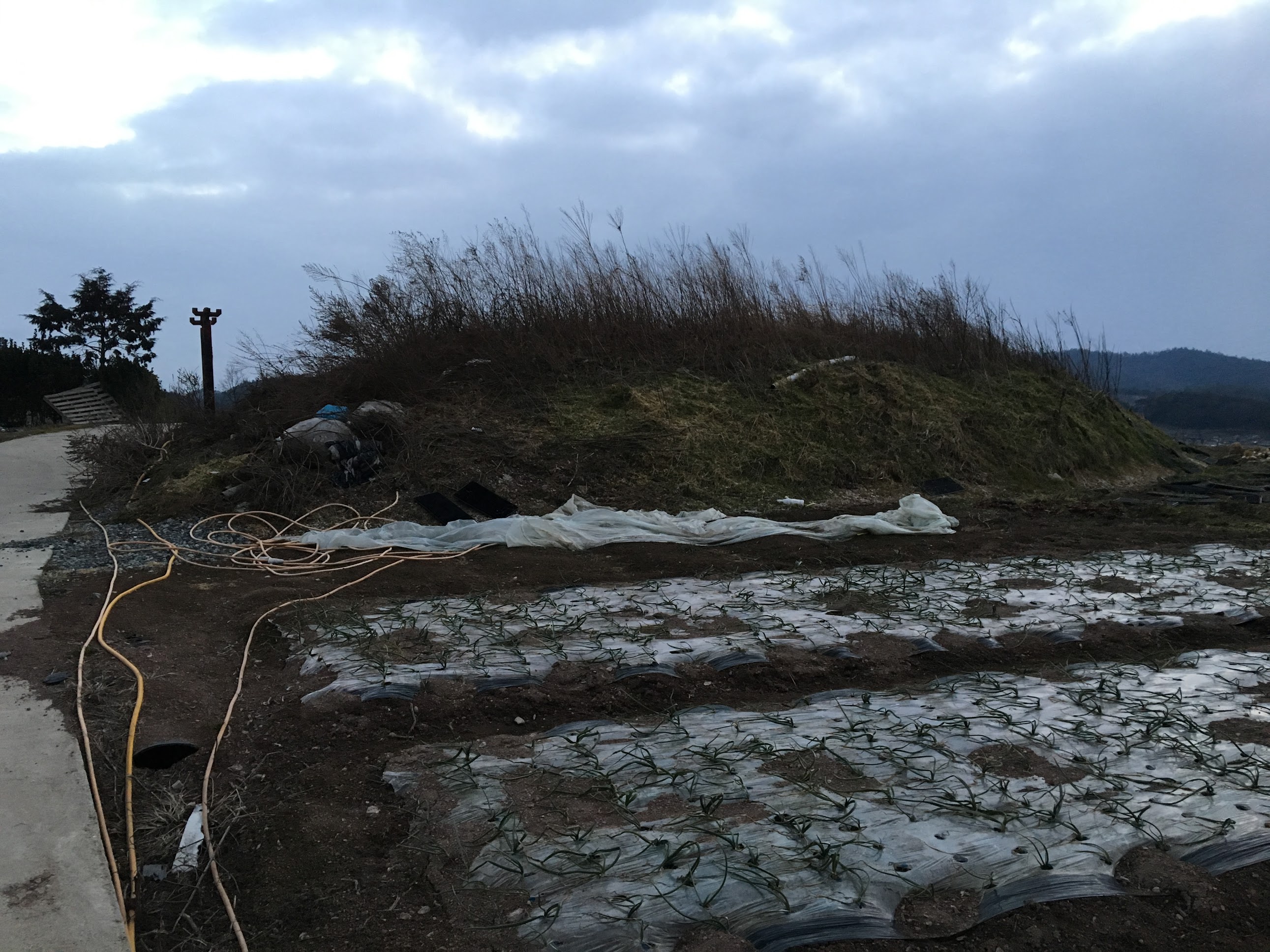
At dusk, when one climbs to the summit of Byeolmoe (星山, “Star Mountain”), the gently rolling hill on the Eomda plain in Hampyeong, the flow of time seems to be felt at a different density. Beneath one’s feet sleeps a tumulus infused with the breath of the Mahan people of 1,700 years ago, and before one’s eyes the golden fields stretching along the Hampyeong Stream and the setting sun form a magnificent spectacle. Before this serene yet majestic scenery, we are naturally seized by awe and led to ask: “Who am I, and what does this land remember?” This personal experience soon leads to a scholarly question. How could a single place hold the stories of so many eras, stacking layer upon layer of memory? This forgotten tomb is, beyond a mere archaeological object, also a place that embodies the “Ruin Aesthetics” where the flow of time and human memory intersect.
The purpose of this study is to reveal the process by which the Jedong Tumulus in Hampyeong has functioned, beyond a mere archaeological feature, as the tomb of a ruler of a Mahan (馬韓) statelet in the Samhan period, the astronomical observation site of a Confucian scholar in the Joseon period, and the sacred ground of folk belief in the modern and contemporary era. To this end, it comprehensively examines archaeological materials such as the tumulus excavation report, historical materials such as Joseon-era geographical treatises and literary collections, and folklore materials such as recorded oral testimonies. It also takes Maurice Halbwachs’s theory of collective memory and Pierre Nora’s concept of the site of memory (lieu de mémoire) as its theoretical framework, in order to argue that Byeolmoe has functioned as a symbolic anchor of memory linking fractured histories. Halbwachs’s observation that collective memory is essentially formed within a social context and selectively constructed, together with Nora’s insight that “there are lieux de mémoire (sites of memory) because there are no longer milieux de mémoire (living environments of memory),” will serve as useful keywords for interpreting the history of Byeolmoe—long forgotten and then summoned forth once more.
II. The First Layer: Ancient Power and Astronomy – The Tomb of a Mahan Ruler
The first layer of the Jedong Tumulus dates back to Mahan (馬韓) society around the 3rd–4th centuries CE. The excavation conducted in 2024 confirmed a structure in which two jar coffins (甕棺) were buried beneath a single mound. The two jar coffins formed a joined-mouth (合口式) double burial arranged in an “ㄱ”-shape relative to the ground. Joined-mouth burials are known to be a typical feature of the highest ruling-class tombs in the Mahan society of the Yeongsan River basin. Indeed, the tombs of the ancient Yeongsan River basin had a custom of multiple burial (多葬), in which several bodies were interred together beneath one large mound much like a modern communal cemetery, and those buried together in a single mound are presumed to have been a group closely bound by ties such as kinship. In particular, the existence of the large jar coffins (독널, “pottery coffins”) found only in the Yeongsan River region, together with the arrangement of multiple coffins within a single tomb, vividly illustrates the familial or hierarchical solidarity and power structure of Mahan society. The “ㄱ”-shaped arrangement, however, is a rare case, differing from the parallel arrangement along a shared long axis that was the region’s common form.
A notable excavated artifact is the bronze mirror found at the bottom of Jar Coffin No. 1. In ancient East Asia, the bronze mirror functioned beyond a mere everyday utensil as a symbol of the sun and the heavens and as a prestige good (威信財) signifying the sacred authority of a ruler. The presence of the mirror suggests that the person interred in this tomb was not a mere village headman but a chieftain endowed with priestly powers. In actual ancient societies, those in power often interred in their tombs objects symbolizing the sun, moon (日月), and the heavens in order to proclaim the legitimacy of their rule. Supporting this, from the Bronze Age of the Korean peninsula onward, there is confirmed a practice of constructing the tombs of those in power atop the hill with the finest view in the region and burying within them bronze weapons or mirrors symbolizing authority. The Jedong Tumulus, too, can be seen as having been constructed amid precisely such topographical and symbolic considerations.
Furthermore, the fact that only a bronze mirror was excavated—without the iron implements, horse trappings, and other grave goods commonly found in the tombs of typical male rulers—is significant. The reason only the bronze mirror remained may be the looting incident around 1940; oral tradition holds that the objects looted at that time were the Cheonmundan relics. At the time, people had no idea that a tumulus existed; it was only in 1986, when the Goseong Jeong clan was refurbishing the Cheonmundan site, that a jar coffin was discovered, finally revealing that this was a large square-style tumulus. Cases of jar coffins furnished with a mirror but no weapons have been confirmed multiple times among female interments in the Yeongsan River sphere. Although genetic identification of the person interred in the Jedong Tumulus appears likely to remain difficult even in the future, since the skeletal remains have completely decomposed owing to the acidic soil, recent DNA studies raise the possibility that the Yeongsan River jar-coffin society had a matrilineal kinship structure. Meanwhile, the Jedong Tumulus is markedly smaller in scale than the various tumulus clusters of Hampyeong to its north and the Bannam tumulus cluster of Naju to its south, and it does not form a dense cluster of tombs; nor have settlement sites or defensive facilities been found in the surrounding area. This is a distinctive feature of the Jedong Tumulus, differing from the general Bronze Age sites of the Korean peninsula.
The location of the tumulus is likewise the product of a deliberate choice. Standing atop the Byeolmoe hill, one takes in at a glance the vast plain of the Hampyeong Stream basin to the northeast, while to the southwest higher mountain ridges block the view. This is closer to a visual staging meant to display sovereignty—overlooking the agricultural lands and settlements of their own domain, and the Hampyeong Stream basin that, at the time, was likely a waterway leading past the Yeongsan River to the sea—than to a defensive vista wary of outside forces. In other words, the tomb’s owner placed the grave in the direction open toward the land they ruled, seeking to reign like an eternal watchman.
That said, the fact that only two jar coffins were excavated suggests that perhaps their dominion did not last long. The power that built the Jedong Tumulus was one among many Mahan statelets and did not even leave behind a name. If we exercise bold imagination, then in the 3rd–4th centuries, when the convergence and dispersal of Mahan statelets was fierce, this region may have been a kind of contested zone between the statelet of the Hampyeong area to the north and that of the Naju area to the south—until a short peace was achieved by the emergence of a figure who governed the sunrise and the movement of the stars and presided over the calendar (曆法) and rites essential to an agricultural society: that is, a female priestess who realized the authority of heaven upon the earth. Thus, into the deepest layer of the Jedong Tumulus was inscribed the memory of “the tomb of a Mahan ruler backed by the authority of heaven.”
III. The Second Layer: A Reordering of Confucian Order – The Cheonmundan (天文壇) of a Joseon Scholar
After roughly a thousand years had passed since the memory of Mahan was buried in history, the Jedong Tumulus long remained a hill of oblivion, forgotten for a time. Although the concrete memory of the Mahan era had vanished, the imposing and sacred aura conveyed by Byeolmoe’s scenery and the enormous mound itself survived in folk oral tradition as the enigmatic name “Byeolmoe” and the legend of a “horse tomb (malmudeom).” Then, in the mid-16th century of Joseon, a figure appeared who endowed this tomb with new meaning: none other than Gonjae (困齋) Jeong Gae-cheong (鄭介淸, 1529–1590), a leading figure of the Honam Confucian literati.
Jeong Gae-cheong withdrew from office in the 1570s and retired to his hometown, Jedong Village in Eomda, Hampyeong. It is said that atop this mound he tamped down earth to build a “Cheonmundan (天文壇)”—that is, an altar for observing the stars of the heavens—and that there, together with his disciples, he lectured on the movement of the celestial bodies and on Neo-Confucianism. The topography of Byeolmoe, open on all sides, was an ideal location for astronomical observation. At this Cheonmundan, Jeong Gae-cheong observed the heavenly signs at night so that the residents might prevent disasters. The already-existing gently rounded tumulus was more than sufficient to lend the symbolism of an altar (祭壇) drawing near to the heavens. By transforming a nameless, forgotten old tomb into a space of Confucian rationality and scientific inquiry, Jeong Gae-cheong utterly changed the character of this place. It was reordered from a “space of the dead” into a “space of knowledge and edification.”
It seems that part of why Jeong Gae-cheong chose Byeolmoe as a site for astronomical observation was that it was a position commanding a strategic field of view, from which one could survey at a glance the Hampyeong Stream basin and the route leading toward the West Sea. According to oral tradition, the observatory at Byeolmoe also served the role of keeping a close watch on the frequent incursions of Japanese pirates (wagu). This means that the Cheonmundan, beyond a mere institute of scholarship, also doubled as a practical observation post. It is also a symbolic space showing that Joseon literati such as Jeong Gae-cheong, under the ideal of “cultivating oneself and governing others (修己治人),” did not separate the scholarship that inquired into the principles of heaven (self-cultivation) from the practical politics of defending the nation (governing others). In other words, as both a space of knowledge and a military observation post, Byeolmoe once again appeared in local history with its function altered.
After Jeong Gae-cheong’s death, the Jasan Seowon (紫山書院, Jasan Confucian Academy) was founded beneath the Byeolmoe mound in 1616 (the 8th year of King Gwanghaegun) to honor his scholarship and virtue. The Jasan Seowon was an academy enshrining Gonjae Jeong Gae-cheong and his younger brother; thereafter, amid the partisan strife between the Westerners (Seoin) and Southerners (Namin) factions, it was repeatedly demolished and restored, yet was in the end preserved by the local Confucian community. Byeolmoe was recognized as the guardian mountain (主山) of the academy and, rather than being directly damaged, was respected as part of the natural terrain. The mound of the tumulus itself was also preserved as Jeong Gae-cheong’s observatory. This was the decisive occasion that allowed the old tomb to retain its original form without being destroyed or reburied by later powers. In short, the second layer of Byeolmoe in the Joseon period was overlaid with a new memory: a place elevated by a Confucian scholar into an “altar for observing the heavens.”
IV. The Third Layer: The Reverberation of Folk Belief – The Bambyeolgut Lingering at “Byeolmoe”
The image of “celestial patterns (天文)” that the Joseon scholars bestowed upon Byeolmoe later seeped into the lives of the common people and gave rise to a new folk belief. By the late Joseon period, Byeolmoe also became established as an official place name. The Sino-Korean place name Seongsan (星山) already appears on the 18th-century map 《Haedong jido》, and on Kim Jeong-ho’s 19th-century 《Daedong yeojido》 the name is recorded together with its Hangeul rendering Byeolmoe, which has been transmitted to this day. The place name Byeolmoe is written in Chinese characters as “星山” and literally means “mountain of the stars.” This name is not a mere administrative designation; it compactly reveals the core of the memory dwelling in this place.
A separate tradition concerning the origin of the place name Byeolmoe also exists. According to the oral tradition of Byeolmoe Village, the origin of the place name “Byeolmoe” is as follows. On the southwestern foot of Seongsan, Yun Je (尹濟), a 22nd-generation descendant of the Papyeong Yun clan, migrated from Muan to receive Jeong Gae-cheong’s teachings and settled here. It is said that the name Byeolmoe (Seongsan) originated because Yun Je likened the mountain contours to the west of this place to a star. Again according to oral tradition, even before Yun Je’s migration, families such as the Kim and Hwang clans had lived in this village. However, in my own view as someone who has surveyed the site firsthand, I could find no place to the west of the village (the western side of Byeolmoe) that evokes a star. Moreover, the Seongsan Yun clan (local people commonly call this prosperous lineage the Seongsan Yun) claim that all the place names of the village originated from Yun Je, the founding settler (入鄕祖). Therefore, the above oral tradition about the origin of the village name is most likely a tale meant to honor the founding settler of the Seongsan Yun clan, who established their hereditary residence in the village. Given the strong association with the historical fact of the “Cheonmundan,” it is more natural to regard the place name Byeolmoe (Seongsan) as reflecting a regional collective memory that existed even before Yun Je’s migration. That is, the standing of Byeolmoe as a space that communed with the stars of heaven was imprinted into the very place name.
The memory bound up with the stars survived as a local folk ritual even into the early 20th century. As recently as the 20th century, in the area around Eomda-ri, Hampyeong, there was a custom of climbing the peak of Byeolmoe on the night before the first full moon (Daeboreum) of the lunar new year and performing the “Bambyeolgut” (the night-star rite). In the first lunar month, when the Big Dipper rises high at the center of the night sky, the residents would climb Byeolmoe and hold a “buldori” fire ritual, praying toward the stars for a bountiful harvest and well-being. Byeolmoe was still a numinous ground. On reflection, this may be regarded as a case in which the heaven-worship rites of ancient Mahan or the astronomical interest of the Joseon Confucian scholar were transformed and transmitted into the blessing-seeking (祈福) folk belief of the common people. That is, the ancient rite (祭儀) donned the garb of folklore and carried on its tenacious vitality. Although such folk rituals vanished through the colonial period under Japanese rule and the era of industrialization, within the name “Byeolmoe” the memory of the people of old, who once made wishes upon the stars of the night sky, still remains like a lingering reverberation.
V. Synthesis: The Jedong Tumulus as a Palimpsest of Memory
The multilayered historicity of Byeolmoe examined thus far vividly demonstrates how a single place stacks up the memories of several eras. This is much like a palimpsest, in which new text is written over the traces of writing erased layer upon layer. Upon the Jedong Tumulus—seemingly nothing more than a single peak—the power of Mahan, the scholarship of Joseon, and the folklore of the modern era were inscribed with intervals of time. Although a new story was overlaid in each era, the archetypal symbols of “the heavens” and “the star” were never wholly erased, remaining as a theme running through every layer. It is as if the faint traces of old writing showing through the parchment influenced the new writing. This phenomenon corresponds precisely to the concept of the site of memory (lieu de mémoire) defined by Pierre Nora (P. Nora). According to Nora, wherever the living, breathing environments of memory (milieux de mémoire) disappear, sites of memory emerge that seek to hold the past in place. Hampyeong’s Byeolmoe is precisely such a case. There was once a living subject of memory in the form of the Mahan ruling class, but after they vanished, Byeolmoe itself came to stand at the center of communal memory as a symbol testifying to the past.
Going further, the case of Byeolmoe may be called a Korean archetype of the universally observed “persistent place.” Archaeologists call the phenomenon of a place being used repeatedly over long ages a persistent place, and they point to the place’s special natural and cultural attraction as the background for this. For instance, a place with abundant drinking water, unusual topography, or the legacy of earlier generations has the power to draw people in even as the ages pass. In the case of Byeolmoe, it seems that the geographical excellence of being able to survey all directions, combined with the symbolic image of seeming to touch the heavens, aroused the instinctive interest of the people of each era. Human beings are instinctively drawn to high places with good views, and before a vast and ancient existence that surpasses themselves they feel a sublime awe and seek to find the meaning of life. Byeolmoe may be called precisely the space onto which that instinctive attraction and the desire for meaning have been repeatedly projected over thousands of years.
In history, one can find many similar cases in which several layers of time have accumulated in a single place. Ganghwa Island’s Chamseongdan was never completely forgotten; known as a place where heaven had been worshipped since the time of Dangun, it was used for astronomical observation right up to the Joseon period, and in the modern era it has come to be regarded as a sacred ground of the nation’s founding myth and a venue for state ceremonies. The Pantheon of ancient Rome was originally built as a pagan temple for all the gods, but from the 7th century onward it was rededicated as a Christian church and remains in use to this day. The Neolithic tomb Newgrange in Ireland was once forgotten and then newly endowed with meaning in the later legends of the Celts as the mysterious birthplace of fairies and heroes. As these cases show, even as eras and uses change, the persistence of the place is maintained, and the people of each era have added the story of their own age atop the traces of the past. Byeolmoe in Eomda-ri, Hampyeong, has likewise accumulated a Korean communal memory upon this palimpsest of memory.
VI. Conclusion: Byeolmoe, the Hill That Is Not Forgotten
The Jedong Tumulus in Hampyeong, Jeollanam-do—also known as Byeolmoe—can no longer be regarded as a relic belonging to a single era. It is a living stratum of history, formed by the layer-upon-layer accumulation of the authority of a Mahan ruler, the reason of a Joseon scholar, and the yearnings of the common people. By tracing the formation and transformation of this multilayered landscape across the boundaries of archaeology, history, and folklore, this study has sought to elucidate how a single place mediates memory and shapes communal identity. As a result, it has been revealed that Byeolmoe—going from a village tomb to a heavenly altar and again to a folk sanctuary, through ceaseless reinterpretation and reuse—has served as a concentric circle of memory for the local community. And in this very moment, when its identity has been revealed through archaeological excavation, Byeolmoe has come to fully embody the “Ruin Aesthetics” wrought by human intention and the weathering of time. Just as a ruin is not the complete absence of the past but a powerful medium that allows us to imagine the past within the present, the scenery of Byeolmoe—where scrub grass, wind, and the light of sunset mingle atop the mound—ceaselessly poses questions to us.
The case of the Byeolmoe Jedong Tumulus makes us consider what we must safeguard in preserving cultural heritage. It is not simply the physical original form of the mound. The work of preserving the multilayered stories stacked within it—that is, the palimpsest of time itself—and of interpreting and transmitting it to later generations must be carried out together. This small hill, Byeolmoe, is a precious place where past and present converse, and where the individual’s existential questions meet the collective memory of the community. In order to understand this heritage even more deeply in the future, I hope that research from many angles will proceed—such as the microscopic analysis of artifacts in the soil and the further excavation of oral traditions not preserved in documents. Forgotten for over a thousand years and now standing once again in silence, Byeolmoe, under the setting sky today as well, tells those who visit it the story of time—wordlessly, yet in the deepest of voices.
Notes
-
This paper synthesizes the 2024 Jedong Tumulus excavation survey, modern local gazetteers (Hampyeong-gun ji, Hampyeong Village Origins Record), Joseon-era historical sources and maps, the author’s field surveys (annually since the 2000s), and personal recordings of oral testimony (annually since the 2000s).
-
Maurice Halbwachs, On Collective Memory. Halbwachs argued that individual memory is thoroughly constructed within a social framework, and held that collective memory has a selective and mutable character.
-
Pierre Nora, “Between Memory and History: Les Lieux de Mémoire,” Representations, No. 26 (1989). Nora explains that, together with the disappearance of living communities of memory, lieux de mémoire—that is, monumental sites of memory—emerge.
-
Materials from the permanent exhibition of the Naju National Museum. As a characteristic of the Mahan tumulus culture of the Yeongsan River basin, it introduces the practice of burying multiple jar coffins beneath a single mound and the use of large jar coffins (독널, pottery coffins). The structure of the Jedong Tumulus can be interpreted in this context as well.
-
The damaged Layer VIII in the 2024 Jedong Tumulus excavation survey appears to be a trace of this incident. The looting incident is transmitted by oral tradition.
-
The excavation of only a bronze mirror as the sole grave good, traces of a matrilineal society in the jar-coffin tombs near the Yeongsan River, the absence of weapon finds, the isolated location lacking defensive facilities and settlement sites, and the fact that it did not form a tumulus cluster are, on their own, insufficient to draw the narrative conclusion of “a short peace in an age of female priestesses.” This is all the more so given that weapons were excavated at the Hampyeong-area tumulus clusters to the north of the Jedong Tumulus. Nevertheless, this paper has attempted a bold inference within the gap between records and the absence of artifacts.
-
The Eomda plain visible from the Jedong Tumulus was once a vast river island (하중도, fluvial island) formed where the Hampyeong Stream met the Yeongsan River. Through flood-control and reclamation projects carried on from the Joseon period through the Japanese colonial era, the Eomda plain took on its present form. Judging from the dolmen remains still scattered throughout Eomda-myeon to this day, it appears that people had inhabited this region even before the Jedong Tumulus. It is possible that, as at the Jungdo site in Chuncheon, the Eomda plain was a dwelling place of the past, and that beneath the rice paddies now filling the Eomda plain there exist Bronze Age settlement remains. Of course, it is also highly possible that most of them have been destroyed by long-term reclamation.
-
Records relating to Hampyeong’s Byeolmoe and Jeong Gae-cheong’s “Cheonmundan” are transmitted through Hampyeong-area local gazetteers and Hampyeong Times articles. For example, according to a Hampyeong Times report, “this tumulus, once called a ‘horse tomb (malmudeom)’ in the vicinity, came to be called ‘Cheonmundan’ because it was the site where Master Gonjae Jeong Gae-cheong inquired into the principles of heaven.” This shows that Byeolmoe was recognized by the Joseon-era Confucian literati as a scholarly and national-defense stronghold. That said, no record of astronomical observation survives in Jeong Gae-cheong’s own writings.
-
Most of the oral testimony cited in this paper was drawn from the ‘Hampyeong-gun Village Origins Record (1989)’.
-
The oral tradition that Hampyeong’s Cheonmundan served as an observation post against invasions by Japanese pirates is somewhat ambiguous. If the founding of Hampyeong’s Cheonmundan is dated to the 1570s, there was no incident of a Japanese pirate invasion that Jeong Gae-cheong could have observed firsthand from here. The only event involving Japanese pirates during his lifetime is the Jeonghae Waebyeon (1587), but at that time Jeong Gae-cheong held the office of Jeonsaengseo jubu (典牲署主簿) and so most likely resided near present-day Huam-dong in Seoul. Therefore, it is more reasonable to regard the agent of the pirate-watching as the nearby residents rather than Jeong Gae-cheong himself.
-
Given Byeolmoe’s location, a role as a lookout was possible at any point before or after the founding of the observatory. As discussed above, the oral tradition that Hampyeong’s Cheonmundan served as a Japanese-pirate observation post may have been transmitted in distorted form. It is possible that its origin as an observation post stemmed from bandits in the distant Mahan era or from Japanese pirates at the end of the Goryeo period, and that later, with the detailed origin forgotten, that origin was attributed to Jeong Gae-cheong, who left behind the material footprints of a Cheonmundan and a seowon here. Of course, irrespective of this, one cannot ignore the possibility that it was simply a functional meaning assigned by later generations.
-
There is a claim by local residents that Jeong Gae-cheong, who was well versed in astronomy and geomancy, could not possibly have been ignorant of the identity of the Jedong Tumulus. According to this, Jeong Gae-cheong, in order to protect the Jedong Tumulus from damage by reclamation or from looting, would have stacked stones along the four-sided walls of the tumulus and built the Cheonmundan directly atop the tumulus. However, the claim that a Confucian scholar would willingly build a Cheonmundan atop a tomb is also hard to accept readily. Perhaps even at the time Jeong Gae-cheong was building the Cheonmundan, the Jedong Tumulus—or Byeolmoe—was still regarded by local residents as a numinous place for observing the sunrise and the movement of the stars.
-
According to the oral tradition of the nearby Jedong Village recorded in the Hampyeong-gun History (2010), a fish called “jeon” is said to live here at Byeolmoe. “Jeon refers to a fish whose head is that of a dragon and whose tail is that of a carp. On the hill behind the village there is a valley called Seowon-gol, and among those still living there is someone who claims to have seen this fish. Two of these jeon are said to have lived here; one was caught and eaten by Gonjae Jeong Gae-cheong, and the remaining one is said to be here to this day.” How should we take this legend? Might we surmise that Jeong Gae-cheong confronted the shamanistic belief that had been here (perhaps carried down from the Mahan era) and absorbed its influence?
-
The founding-settler tale of Byeolmoe Village, which sought to interpret an indigenous place name as a founding-settler place name, also deserves respect in that the local residents added their own interpretation to the forgotten old memory of Byeolmoe. However, the theory of Byeolmoe as a founding-settler place name becomes even less persuasive when one considers that there are place names such as Wolsan (月山, “Moon Mountain”) and Seongam (星岩, “Star Rock”) in the vicinity.
-
The Byeolmoe first-lunar-month Bambyeolgut was called “buldori” in the oral testimonies. The reason I deliberately named it “Bambyeolgut” is an arbitrary designation of this paper, meant to emphasize the character of the custom in question.
-
I heard the story of the first-lunar-month Bambyeolgut custom at Byeolmoe directly from my grandfather, who spent his whole life in a place within sight of Byeolmoe. It would be romantic if the Byeolmoe first-lunar-month Bambyeolgut had been handed down all the way from the distant Mahan era, but according to oral tradition, the founding of Beondong Village—the oldest village in the vicinity—dates to the Goryeo period 700 years ago. Again according to oral tradition, the original name of Beondong Village was Bongol (本洞), and it came to have this name because it was the foundational village (本洞, “root village”) of the various nearby villages. It is unfortunate that there are no detailed records.
-
This paper uses the palimpsest as its core metaphor, but it does not wish to confine the discussion to mere overwriting. It has paid attention to the phenomenon whereby the memory of a previous layer survives, however faintly, and influences and transforms the interpretation of the next layer.
-
Brad Lepper, “Persistent Places,” Ohio Archaeology Blog (2012). An essay explaining, from an archaeological perspective, the phenomenon of a place being continuously utilized across generations; it serves as a reference for understanding cases such as Byeolmoe.
-
The change in the Pantheon’s use is detailed on the information signage of the City of Rome, Italy, and in related studies. In 609, the Pantheon was converted into the Church of St. Mary by Pope Boniface IV, and it has been used as a Christian place of worship for some 1,400 years since.
-
The mythologization of Newgrange is confirmed in Celtic folklore materials. The Neolithic megalithic tomb of Newgrange was long forgotten and then reinterpreted in medieval Irish mythology as the sacred space of the divine race the “Tuatha Dé Danann” and as the resting place of the Dagda, king of the gods. This is a representative case in which a prehistoric site acquired new meaning within the imagination of a later culture.
References
- Article on the Jedong Tumulus excavation
- Hampyeong-gun Village Origins Record Publication Committee, [Hampyeong Village Origins Record], Hampyeong-gun, 1989
- Hampyeong-gun History Compilation Committee, [Hampyeong-gun ji], Hampyeong-gun, 2010
- Haedong jido
- Daedong yeojido
This article was written with the assistance of ChatGPT and Gemini.
EOD
20250717
Leave a comment