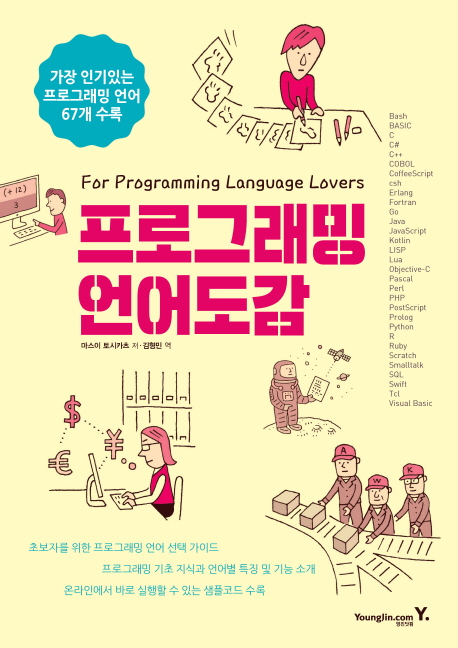
An Illustrated Guide to Programming Languages
This is truly an ambitious undertaking. It covers 67 programming languages. Doing justice to even one is hard enough, yet here we have a whopping 67. And it’s not as if it skims over a handful of languages made just for fun, either. Every one of them is a legitimate language in its own right. Of course, being an illustrated guide, it doesn’t go into great depth. It catalogs what concept each language is built on, what its characteristics are, and the kind of information that’s worth knowing as a programmer and worth referring back to someday. Watching the various approaches humans have taken in their attempts to converse with machines, you might even tear up a little. The book includes an implementation of the Tower of Hanoi algorithm written in each language, so there’s also the fun of reading the code. As a cheerful programmer who enjoys development, it’s a fine light read. What’s interesting is that the more absurd or flimsy a language looks, the more surely it turns out to be Turing complete. I suspect that these oddball languages were probably included precisely because, strange as they are, they’re Turing complete.
20181101
Toshikatsu Masui. 2017. An Illustrated Guide to Programming Languages. Translated by Kim Hyung-min. Youngjin.com
Leave a comment