
Trade and Economic Growth in the Iron Age
Trade and Economic Growth in the Iron Age
There has been a great deal of debate lately about the effects of free trade. Policies that restrict trade are gaining ground. Of course, ever since Adam Smith and David Ricardo, economists have argued that free trade is beneficial. The problem, however, is empirical evidence. Not only is empirical evidence hard to come by, but most of it concerns only recent phenomena. Empirical economists have tried to demonstrate the relationship between open economies, integrated markets, and rapid economic growth. But there is an even harder question. Does trade drive growth, or are more prosperous economies simply more open?
Thanks to much recent research, we have been able to untangle this causal relationship to some extent, by examining historical events such as the introduction of new technologies or the opening of new trade routes. A study on how the growth of cities along the border between East and West Germany slowed after World War II. The impact of the expansion of U.S. railroads in the 1870s and 1890s on agriculture. A study showing that the expansion of U.S. highways in the late 1950s raised retail sales by 10%. Air transport likewise increased revenues and profits, and steamships opened up new trade routes. All of these brought economic benefits from trade. There are also research findings, however, suggesting that such economic benefits are observed only in countries with inclusive political institutions.
Even so, all of these episodes are recent events. Naturally, the question arises: isn’t this all because of the Industrial Revolution? But let us dig deep into history. Trade has played an important role for a very long time. After 1500, when the Atlantic routes opened, Europe’s economic center shifted from southern Europe to the Atlantic coast. We analyzed the growth effects triggered by humanity’s first expansion of trade, which occurred in the first millennium BC—the event in which the Phoenicians built a trading system spanning the Mediterranean.
Merchants and Rats in the Age of the Phoenicians
The earliest seafaring in the Mediterranean began in the hunter-gatherer societies of 10,000 BC. During this period, people began to settle on islands and carried obsidian, volcanic rock, and the like over considerable distances. By 3000 BC, advances in seamanship had made transport by ship far cheaper than overland transport. And throughout the second millennium, regional trade networks in the Mediterranean became increasingly important. Most voyages, however, were coastal voyages. Open-sea voyages were undertaken only when unavoidable, such as the routes running from Cyprus, Crete, and Albania to the heel of the Italian peninsula. It was only around 900 BC that the Phoenicians were able to cross the Mediterranean systematically and regularly. At last a dense trade network began to form, and just before classical antiquity (translator’s note: the era of ancient Greece and ancient Rome, from the 8th century BC to the 5th–6th century AD), the Mediterranean became an arena ceaselessly crisscrossed by the Phoenicians, the Greeks, and other seafarers.
This expansion of trade vastly surpassed, in both scope and scale, all trade up to that point. The house mouse is an indicator of this expansion. Originating in Southeast Asia, this species reached the eastern shores of the Mediterranean around 12,000 BC. And it took 10,000 years to spread from southern Anatolia to northeastern Africa. Even in 1000 BC, these mice were almost absent from Greece. But once trade in the Mediterranean began in earnest, these mice began to appear with extraordinary speed all the way to the central and western Mediterranean.
Empirical Evidence
To analyze whether this increase in trade really did lead to economic growth, we focused on the following point. Not every point along a coast is suitable for open-sea voyaging. Accordingly, every coast has a different degree of accessibility. The shape of the coast and the location of islands determine how difficult it is to reach other regions that could become trading partners. Figure 1 shows the results of measuring this. For example, the Aegean Sea, southern Italy, and Sicily have far better accessibility than other regions.
We took accessibility as a measure of trade opportunity.
Figure1. Log connectedness at 500km distance
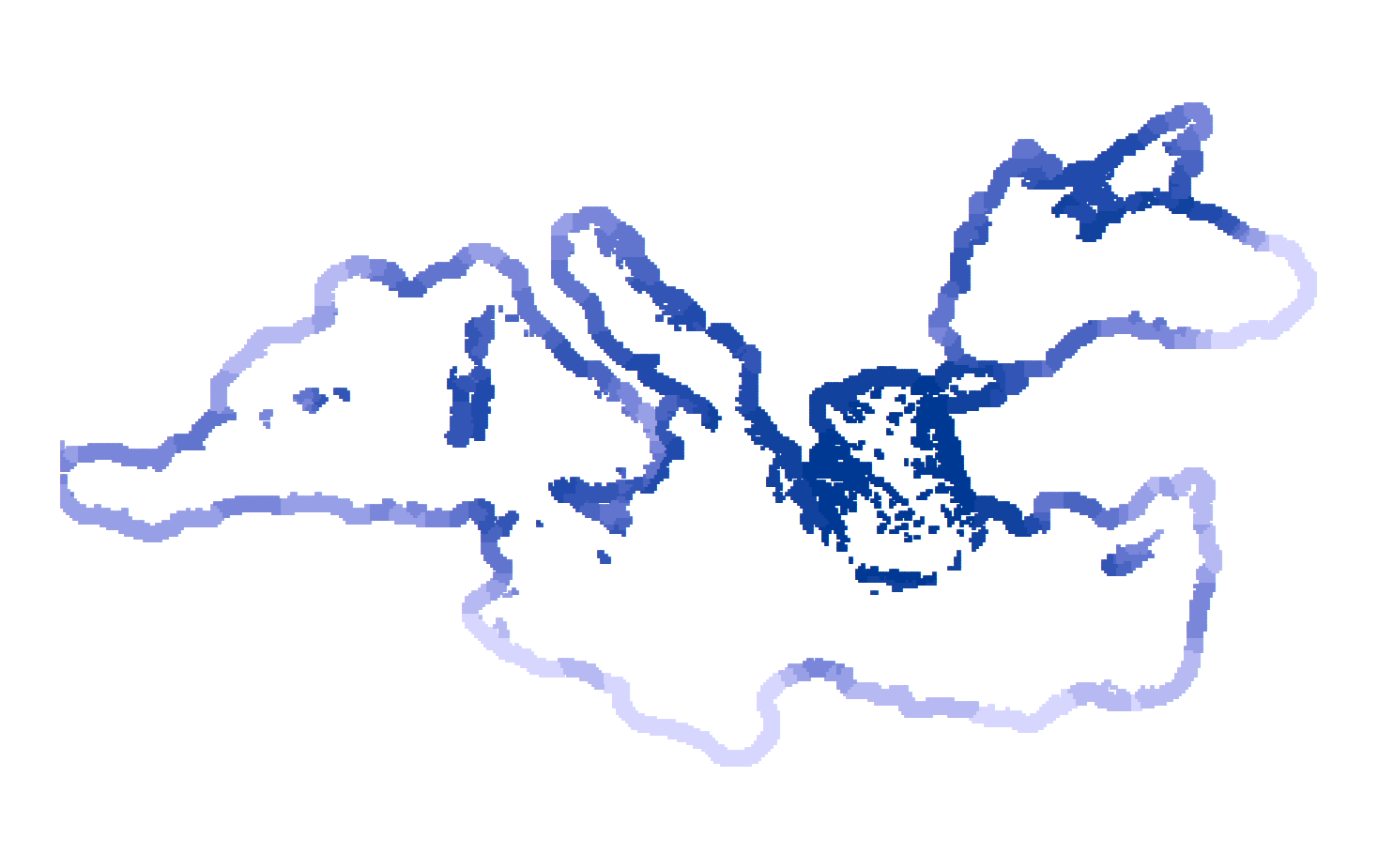
Measuring economic growth in the early stages of human history is difficult. There is no income data, no GDP, no population figures. So we used the settlements and urbanization found at archaeological sites as a measure of economic growth. Of course, this is not a perfect method. But more sites imply more human presence and activity. We therefore linked the number of archaeological sites in a given period to the accessibility measured above.
Accessibility and archaeological sites showed a substantial degree of correlation. The effect of trade accessibility on the economic growth of the Iron Age Mediterranean world was twice as large as the effect that U.S. railroads had on the U.S. economy. The two cannot, of course, be directly compared, but a magnitude of this kind suggests that, even in early history, both geography and the development of trade played a major role.
When we applied our analysis to other time periods, the effect during the second millennium BC was relatively small, and the effect grew considerably from 750 BC onward. This is consistent with the fact that trade became active in the Iron Age. Of course, one must take into account that the earlier the era, the harder it is to find sites.
The effect of accessibility peaks around 500 BC, and weakens gradually thereafter. The fact that the accessibility effect weakened even at the very height of the Roman Empire, which spanned the entire Mediterranean, is puzzling. We surmise that this is probably because, between 900 BC and 500 BC, all the most accessible locations had already been claimed. Cities founded after 500 BC had poorer accessibility than cities founded earlier. The evidence for this is that the cities founded in this later era prospered steadily (translator’s note: a city with poor accessibility would presumably have declined).
Not a Phenomenon Limited to the Mediterranean
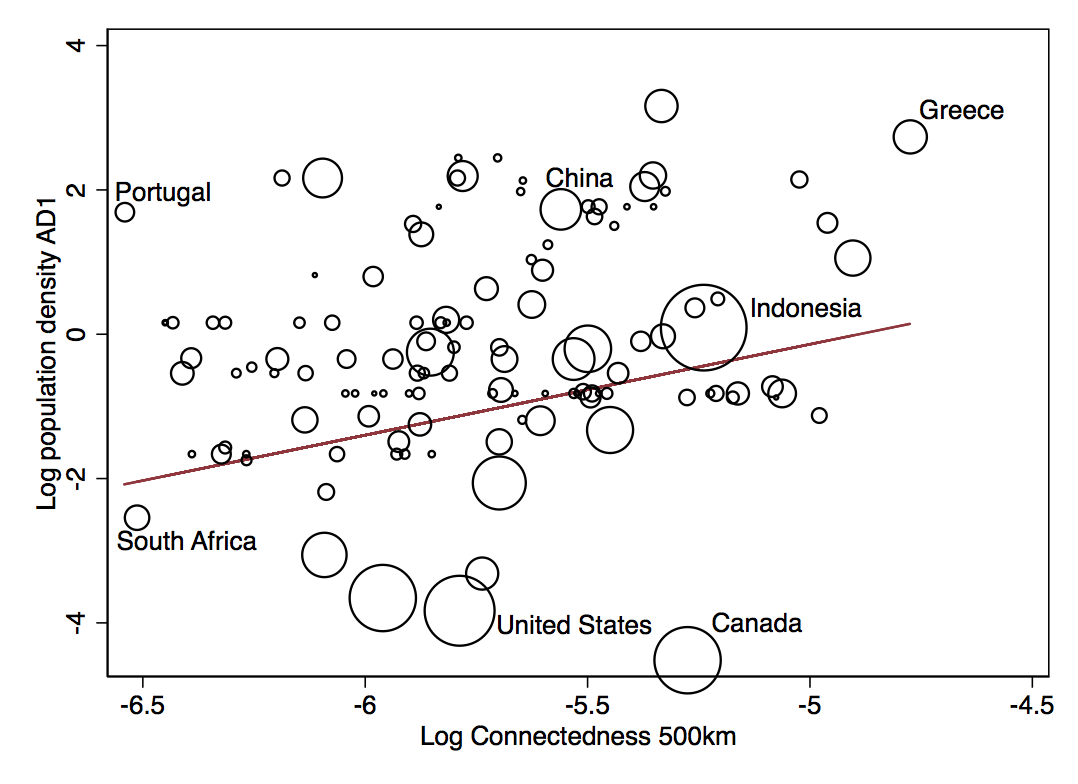
Most of the data we have concerns only the Mediterranean region, but we applied our method on a global scale based on population density in the 1st century AD. As shown in Figure 2, accessibility and population density showed a strong correlation.
Figure2 Relationship between population density in 1 AD and connectedness
Conclusion
Our research shows that accessibility, and the trade opportunities associated with it, are important to human development. Ever since 1000 BC, when regular and frequent open-sea voyaging began, more archaeological sites have been found in places with higher maritime accessibility across the entire Mediterranean coast. Once the advantages of such locations were discovered, they generally maintained their urbanization for centuries thereafter.
I found this an interesting paper, so I translated a summary of it. I liked the bold approach. But I’m not sure whether it counts as empirical research.
The source is https://voxeu.org/article/trade-and-growth-iron-age
Leave a comment