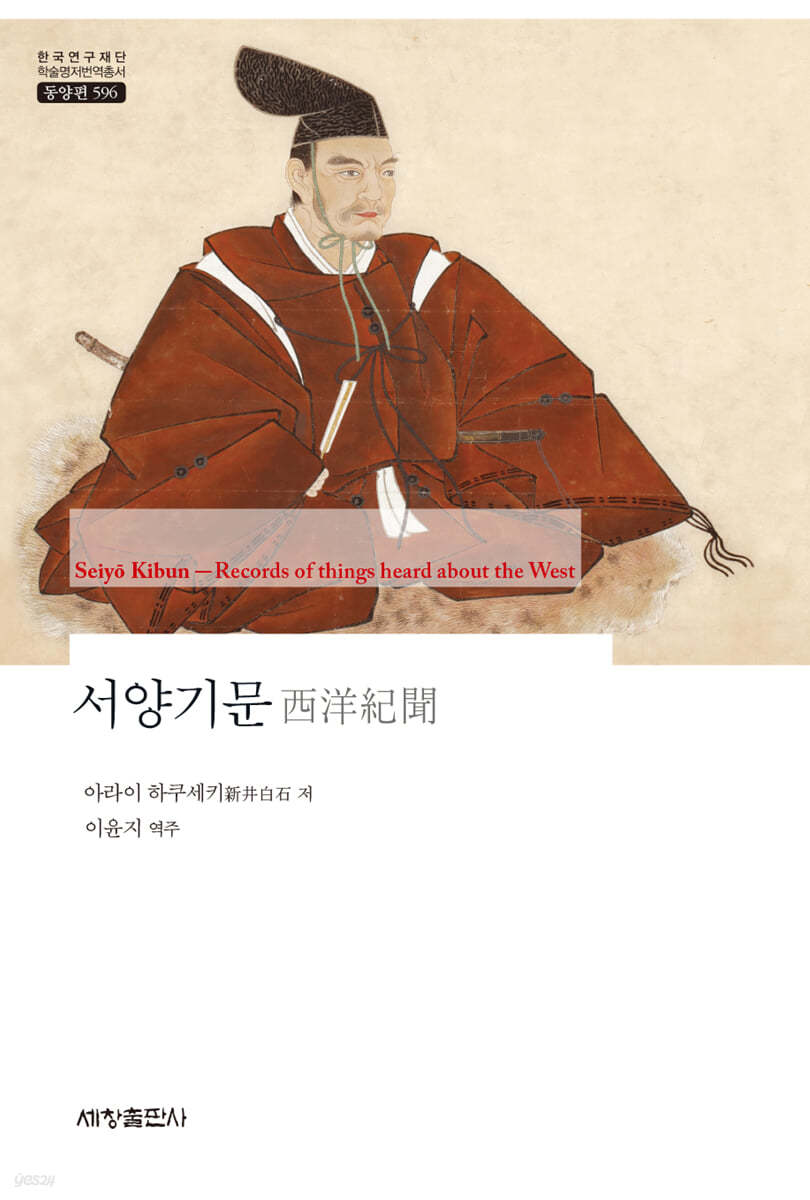
Seiyō Kibun
This is the story of Western civilization as seen by Arai Hakuseki, Japan’s foremost intellect and a maverick thinker in 1700, and of Giovanni Sidotti, a Spanish missionary who gave his life out of religious devotion. Though they met only four times, Arai Hakuseki and Giovanni Sidotti came to recognize each other’s intellect and character. Yet Arai’s position as a vassal of the shogunate and Sidotti’s position as a prisoner captured while doing missionary work were fundamentally irreconcilable. Three hundred years later, now that laws and institutions have changed, it makes me wonder what might have been had the two men been able to share more conversation from equal positions. Might they not have stirred up an astonishing vitality in the world of ideas, just as Matteo Ricci had done in Ming China before their time?
I discussed Arai Hakuseki’s brilliance before in “Neo-Confucianism in History,” but in Seiyō Kibun there is an episode that hints at how Arai assessed himself. When Arai asked Sidotti about the location of the Australian continent, Sidotti suddenly fell silent. When Arai asked why, Sidotti replied: “With your intelligence, Arai Hakuseki, you would lack nothing to become a great figure even in Europe. Australia is close to Japan, so if you set out to seize it, the task would not be difficult to accomplish. But then many people might die, and so I cannot answer.” At this, Arai answered with some embarrassment: “The law is severe, so it is impossible for me to raise an army.” As they had this conversation, Arai surely thought of Toyotomi Hideyoshi. In the age of Hideyoshi—who was born lowly yet won the realm, who ended the civil wars and issued the ban on Christianity and the order expelling the missionaries—Arai Hakuseki’s fate had, in effect, already been decided. An age in which Japan offered an opportunity to give full play to one’s talent and fortune was still 150 years away.
20240410
Leave a comment