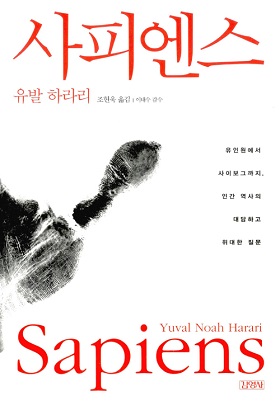

Sapiens
The age of the great historians is over. Sima Qian asked where the Way of Heaven lay in history. But people now ask science about the Way of Heaven. When it comes to who we are and how we live, economists are superior to historians. What is more, countless disciplines such as political science and diplomacy have broken away from history to establish themselves as fields of their own. Perhaps we are living in an era in which one vast discipline is fading away. For someone like me, who once dreamed of becoming a historian, this is a sad thing.
Against this backdrop, ‘Sapiens’ is astonishing. With great boldness, it sets out to touch on every one of history’s grand controversies and press onward. Agriculture, the state, the Scientific Revolution, and so on… each one might well be called the Stalingrad of academia. And yet its prose is lucid, never trailing off in vagueness. The author declares that vast collective cooperation, and the imagination that made it possible, created humanity as it is today. Of course, one could scrutinize the book’s claims in fine detail. But if it comes down to that kind of rigor anyway, history cannot compete with the other disciplines. A story that, however rough, is full of insight. This may be one of the paths along which history can move forward.
Even so, this book is not the kind of fairy tale that ends with mere exhilaration. It repeatedly reminds us that the trajectory of history was never inevitable, that it was coincidence piled upon coincidence. If we believe that the reality we face is by no means an unavoidable fate, then no matter how many times we have repeated our failures up to now, perhaps this time can be different. And the question of what brought about those failures, that is, the battle over the past, will determine the future. As long as concern for the future remains, I believe that history will continue.
Harari, Yuval N. 2011. Sapiens. Translated by Cho Hyeon-uk. Gimm-Young Publishers
Leave a comment