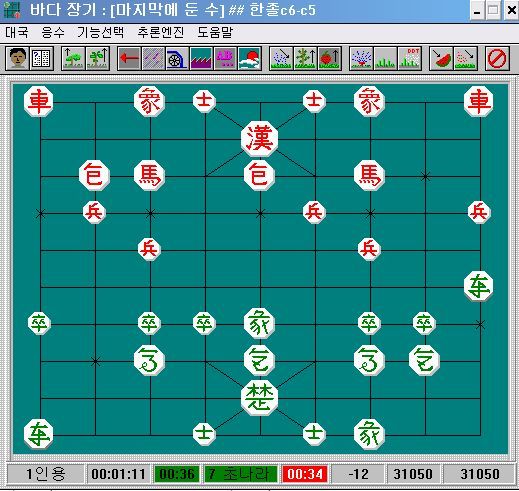

A Story of Developing AI - Memories of Bada Janggi
As a kid, I was pretty good at janggi (Korean chess), not for any particular reason, but simply because I was a little better at it than my peers. Back then there was no such thing as online janggi matches at all, so when it came to janggi I was always full of myself. But even I had an opponent I was completely helpless against: my great-uncle. In the face of my great-uncle’s overwhelming skill, I didn’t stand a chance. Every time I saw him, I would carefully ask him for a game. But my great-uncle was someone I could only meet at the family gatherings that happened a few times a year. As a result, I was always plagued by a thirst for competition.
These days you can find as many janggi opponents as you want online, but back then online gaming meant, at most, playing MUD games like ‘The Land of Dangun’ over PC communication networks. Then one day, I encountered an AI janggi game powered by the tremendous computational power of a computer. It was ‘Bada Janggi.’ I don’t remember whether I came across this game on the early internet or on a PC communication network. In any case, to me at the time, ‘Bada Janggi’ was an incredible master, and I couldn’t win a single game. The same went for another program I encountered afterward called ‘Janggi Master.’ My processing power was no match for the latest computers of the day (I remember the CPU clock was 166MHz). In the end, after much thought, I began to imitate the tactics of these janggi programs, and I drastically changed my playing style too. I went from a style of winning with ingenious, aggressive tactics (which my friends described as being like playing janggi against a con artist) to a style of carefully pressuring my opponent and slowly choking them out. That sounds clever when I put it that way, but in a word, it means that whenever I felt my moves were blocked, I pushed my pawns forward. This was the very playing style of ‘Bada Janggi.’
Of course, training this way didn’t mean I could beat my great-uncle. He crushed me easily, and he demolished even the janggi program that had been my spiritual master with a single muttered ‘Oh, this one’s pretty good.’ After that, the world saw the release of many fun and exciting online games like StarCraft and Diablo, and I lost interest in janggi. ‘Bada Janggi’ remained a faint memory.
A story about developing a Japanese-style chess (shogi) AI brought back these old memories of mine. Only after reading it did I understand the style of ‘Bada Janggi.’ Since it was still an era before machine learning, the computer had been programmed to push its pawns forward and pressure the opponent whenever it couldn’t find my weak spot. If you push your pawns forward, applying pressure upon pressure until your pawns finally reach the opponent’s palace, the match is bound to be decided one way or another. Once you get caught up in this strategy of the computer, it’s probably not easy to win. I had been trying to take on a computer using a computer’s own method, so my chances of winning were hopeless from the start.
It has now been twenty-some years since the days when I enjoyed ‘Bada Janggi.’ Technological progress has already been revolutionary, and various technologies that weren’t even attempted in the ‘Bada Janggi’ era have already gone mainstream. What I mean is that I will never again have any chance of beating a computer at janggi. In the meantime, I have gone from an elementary school student who enjoyed janggi to a developer who makes a living with computers. And as a developer, this kind of technological progress is a joyful thing. How far will the progress continue? Just like in those days when I worked so hard to beat ‘Bada Janggi,’ even now, as a developer, I have no choice but to keep relentlessly chasing after it.
Yamamoto Issei, 2018, A Story of Developing AI, translated by Nam Hye-rim, Cheoeum Books

Leave a comment