Dongbok Restaurant
A few days ago, on my way to work, I noticed a group of workers bustling about. They were demolishing a restaurant. It had been just a month since the place stopped operating. It was a restaurant I used to frequent.
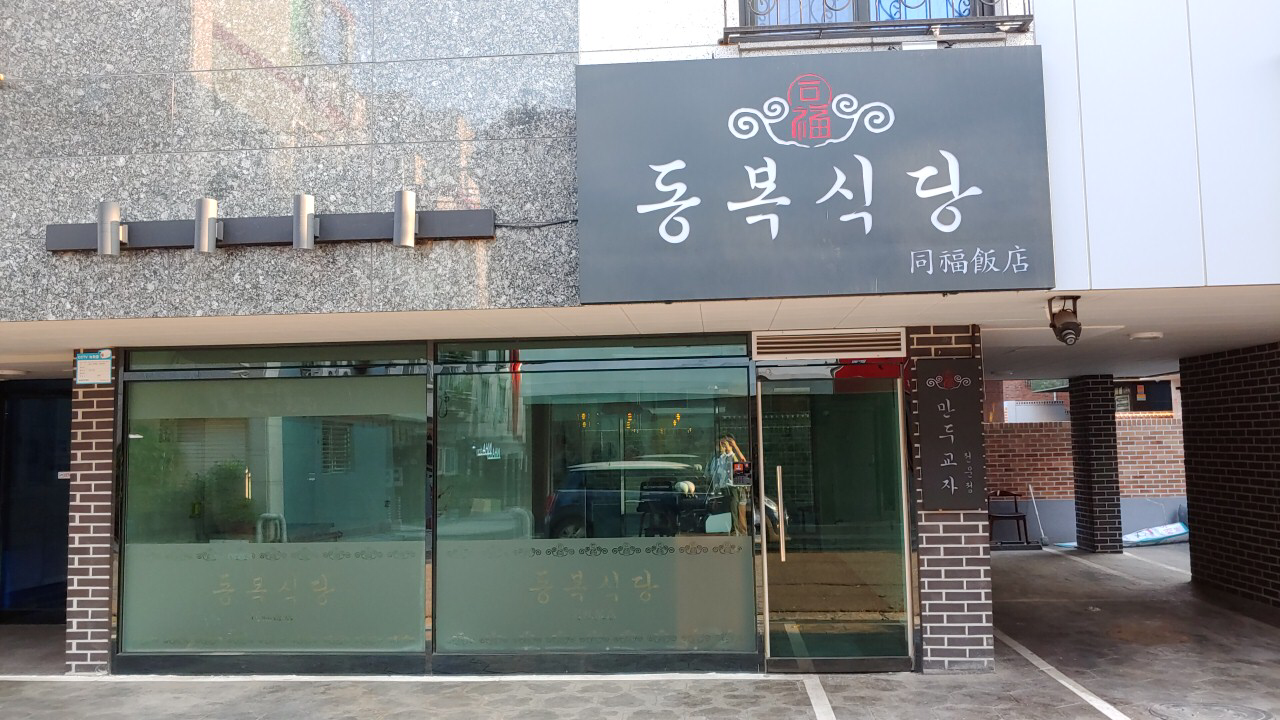
On my way home, I looked at the restaurant again and found that the interior had already been cleanly gutted. A few days later, even the sign had been changed. With a sense of regret, I thought I would unravel a little of the thoughts I had built up about this restaurant over time.
I had been watching Dongbok Restaurant ever since it first opened, because it sat right along my commute to and from work. Coming and going, I kept thinking that I should drop by someday, but it always stayed just a thought. Whenever I looked through the restaurant window at people quietly sharing drinks in cozy company, I felt embarrassed about walking in and sitting down to eat alone. The plaque planted firmly at the entrance declaring it a “dumpling and gyoza specialty shop” gave me pause too. After all, I’m not the kind of person used to eating dumplings as a full meal. And so nearly two years went by.
Having lived as a solitary middle-aged man for close to 15 years, I’d developed a sharp eye for picking restaurants suited to eating alone. There are several tricks, but the most reliable indicator of all is the ratio of people eating by themselves. Say what you will, humans are social animals, and many find it bothersome to go eat alone. People like me are even worse: I often find it so tiresome to eat by myself that I just skip the meal altogether. But even someone like me has those foods that occasionally come to mind, and the logic is that restaurants delicious enough to overcome the hassle are not common. So I’m always running my own solo-dining radar, scouting out restaurants worth visiting, and at some point Dongbok Restaurant started showing up on my radar. It had clearly been a place packed with social butterflies, which made it all the more strange.
Then one day it happened. I had overslept, so mealtime had already passed, there was nowhere to eat on a weekend, and there wasn’t anything in particular I wanted. As I wandered around the neighborhood, I saw that Dongbok Restaurant was completely empty, with no one there but the owner staring at his phone. Taking courage from this, I went ahead and walked in and sat down. When I asked the owner for a menu, he handed me something resembling a desk mat printed in both Chinese and Korean. There was only a single item, and it was neither dumplings nor gyoza. Somehow this place had become a malatang shop. Since I didn’t care whether it was dumplings or anything else, I called out to the owner for a bowl of malatang. The owner then said something in Chinese while gesturing emphatically toward the ingredient refrigerator. I don’t speak Chinese, but from the cues I gathered that the idea was to pick the ingredients I wanted to eat from the fridge, put them in a basin, and hand them over so he could cook a malatang with them. Fortunately, I’d eaten malatang a few times before, so I picked a reasonable selection and handed it to the owner. I added beef too. It was because of the owner’s recommendation, and even though it was a foreign language I couldn’t understand, his sales skills were astonishing enough to make me grasp everything.
While the owner was cooking the malatang, I sat at the table and quietly reflected, and it seemed I’d made a mistake. Thanks to the recent malatang craze, I too had eaten malatang a few times. The results were never good: it tasted pretty delicious while eating, but a storm of diarrhea always followed. Figuring it was because malatang was a hopelessly spicy dish to begin with, I had come to accept the cycle of stormy slurping and stormy diarrhea as a sort of natural order. But the order was already in, so I started rationalizing. Since I was planning to stay home all weekend anyway, even diarrhea wouldn’t be much of a problem, right?
Soon the ingredients I’d chosen came out, thoroughly simmered in a white-and-red malatang broth. It was a properly malatang-like spiciness, without needlessly forcing in sweetness or other flavors. Thankfully, it wasn’t as spicy as the malatang I’d once eaten in Daerim-dong. As I picked through the ingredients with my tongue tingling, a twist crept up on me before I knew it. After eating about half, the malatang was no longer spicy. I could taste a refreshing meat broth that wasn’t greasy at all. I’m not sure whether it was because my tongue had been numbed by mala’s strong stimulation or something else, but either way I was thoroughly satisfied. I normally never drink the broth when eating malatang, but here I didn’t leave a single drop. While I was frantically polishing off the malatang, a male Chinese student came into the shop alone and ordered a bowl of malatang, and he chatted away with the owner in Chinese the entire time he ate. So this is the taste of the continent… That night, even though I’d eaten malatang, I didn’t get diarrhea.
After that, Dongbok Restaurant became one of my favorite spots. It was delicious, well-suited to eating alone, and above all, easy on my stomach. As I went in and out of this restaurant almost every single day (!), I noticed some peculiar things. For one, most of the customers were Chinese international students. And the Chinese people who came here all seemed to roughly know one another. They’d talk with customers at other tables as if at a neighborhood meeting, and they’d talk with the owner too, all in Chinese, so I couldn’t make out a word of it. While sitting alone slurping malatang as if traveling in China, the occasional Korean customer would come in, but most of them, baffled as to why a dumpling and gyoza specialty shop didn’t sell dumplings, would soon leave without ordering. Of course, since they couldn’t communicate with the owner, there was no chance to make a sale anyway. I’d listen quietly, and when I felt like it, I’d explain the situation to the Koreans. They don’t sell dumplings here anymore. They only sell malatang. The owner can’t speak Korean. But for the most part it was too much of a bother, so I’d pretend not to hear and slurp my malatang without a word. The owner didn’t seem particularly grateful to me, nor did he seem to regret the customers who left. Of course, there were occasionally Koreans who, like me, had somehow ended up coming for the malatang. Most of them were devoted to the one path of malatang.
Meanwhile, the malatang craze in the neighborhood grew even fiercer, and malatang shops sprang up here and there like flowers blooming in spring. At some shops you had to line up at lunchtime to eat. Having become a malatang fan at some point, I made a pilgrimage to every malatang shop nearby, and every one of them fell short of my expectations. One place was too sweet; another was just plain spicy. Not a single one produced as deep a flavor as Dongbok Restaurant; they only gave me diarrhea. The only place that could even compare to Dongbok Restaurant was a malatang shop in Daerim-dong, which has by now turned into a Chinatown, but that place gave me diarrhea, so it too wasn’t really edible for me. Yet Dongbok Restaurant, far from having customers line up, was busy driving away the customers who came looking for dumplings. One day a notice was posted on the counter, written on a sheet of A4 paper, and however they’d run Google Translate, the Korean on it didn’t fit the grammar at all. The reason I know they’d used Google Translate is that whenever there was some unavoidable matter to discuss with the owner — for example, if I’d added a bowl of rice but hadn’t paid for it — we always communicated through Google Translate.
It was a day when I got off work late because there was so much to do. Since I hadn’t eaten dinner by nearly 9 o’clock, I thought I’d polish off some malatang at Dongbok Restaurant again that day, and as I looked around, even though the shop lights hadn’t been turned off yet, a group of Chinese people were blocking the shop’s doorway, smoking and chatting all together. The way I knew they were Chinese was that they were faces I’d often seen while going in and out of Dongbok Restaurant all this time. And after that day, Dongbok Restaurant never opened again. For the first few days I didn’t think much of it. I figured they’d gone back to their hometown for a bit. The business hours had always been erratic anyway. But even after a week passed, the restaurant didn’t open, and soon a notice announcing the shop was for sale was printed on a sheet of A4 paper and posted on the door. Come to think of it, even before it closed, they had once posted a paper announcing the shop was for sale on the door while still operating. But that time it had stayed up for a few days and then disappeared, so I’d figured the owner had changed his mind — this time, though, it was not so. The A4 paper had no contact number, only a WeChat QR code stamped on it, and seeing nothing but the QR code of a messenger used worldwide only by Chinese people and those connected to them, I was dumbfounded, wondering whether it meant he’d only sell the shop to a Chinese buyer. Out of curiosity, I scanned the QR code with the WeChat app, and up came the profile picture of what looked like the owner’s daughter (presumably). Thinking about it, since he couldn’t speak Korean anyway, it made sense that he’d stamped on a WeChat QR code.
The A4 paper announcing the shop was for sale disappeared within a few days. Holding onto a faint hope, I checked every day whether Dongbok Restaurant had opened. Of course, the restaurant never came back to life. Only after a month had passed like that was Dongbok Restaurant finally demolished. I suppose the owner’s family (presumably) — who had cooked malatang for me without a word and absorbed themselves in mobile games — went back to their hometown. I have no idea what gave them the nerve to start running a restaurant in a country whose language they couldn’t even speak. They might have done far better business if they’d just taken down the “dumpling and gyoza specialty shop” sign and put up a sheet of A4 paper that said “malatang” instead. In any case, the taste was the real deal, and I haven’t eaten malatang since. With a heavy heart, I close this piece in memory of Dongbok Restaurant.
Leave a comment