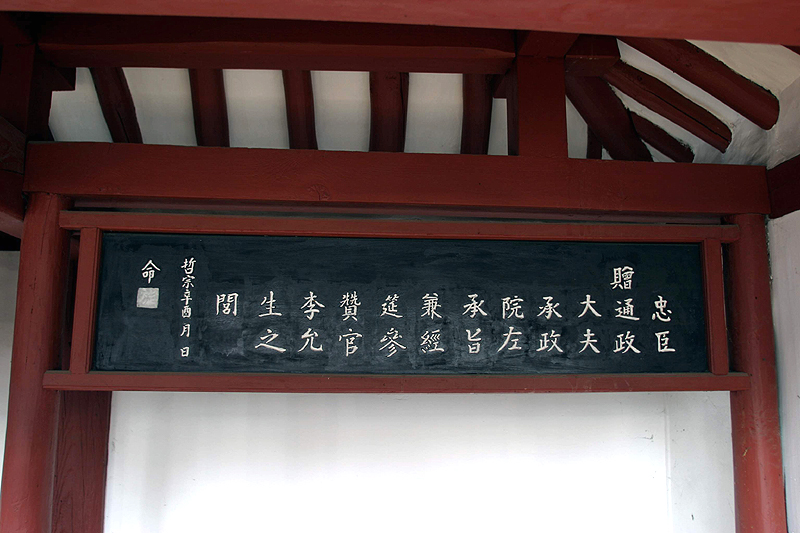

After Reading “Incheon” - The Memorial Gate of Lee Yoon-saeng and Lady Kang
Four hundred years ago, a nobleman named Lee Yoon-saeng lived in Incheon. By that time, the country had already fought one war with a foreign power, and was preparing for the war to come. Lee Yoon-saeng was skilled at archery and horsemanship, and so was given a military post. Whether Lee Yoon-saeng formally passed the military examination, and whether he truly served in the central army officer position he was given, I do not know.
In any case, it was a desperate age, and when war broke out again Lee Yoon-saeng was at his home by the Incheon shore. Lee Yoon-saeng raised a band of righteous militia. Then, together with his militia, he moved onto Nakseom, a small island off the coast of Incheon. At that time there were two main sea routes connecting Incheon and Ganghwa Island, and the one Lee Yoon-saeng was stationed on was the southern route. The enemy, however, attacked Ganghwa Island by way of the northern route.
Everyone believed Ganghwa Island to be a fortress of natural defenses. Since Ganghwa Island had been impregnable throughout history, this was not a baseless belief. The moment the war broke out, the king tried to flee to Ganghwa Island. It was only that the enemy moved far faster than the king could flee. With the road to Ganghwa Island cut off, the king holed up in a mountain fortress. And he resolved to fight to the death. His thinking was that even if everyone in the fortress starved to death, the state could be preserved on Ganghwa Island.
But Ganghwa Island fell in an instant. The commander of Ganghwa Island was drinking and carousing when he was caught off guard, and he could not put up a proper fight. After Ganghwa Island surrendered, it was plundered. There was a massacre. Meanwhile, Lee Yoon-saeng and his militia were still stationed on the small island along the southern sea route. Three days after Ganghwa Island fell, the enemy attacked Lee Yoon-saeng and his militia. After two days of fighting, the militia ran out of arrows. The battle soon turned into a massacre. Lee Yoon-saeng, too, was killed in action. He was 34 years old. When his wife, Lady Kang, heard the news of Lee Yoon-saeng’s death, she threw herself into the sea and took her own life. The island where the battle took place was barely a kilometer from Lee Yoon-saeng’s home, so perhaps Lady Kang watched the scene of the battle, the defeat, and the massacre from afar.
Five days after the deaths of Lee Yoon-saeng and his wife, the king surrendered to the enemy. Upon hearing the news of Ganghwa Island’s fall, the king had lost his will to fight. The deaths of Lee Yoon-saeng and his militia were not even taken into consideration. After the war ended, the state granted his wife, Lady Kang, the title of faithful wife (yeollyeo, a woman honored for her devotion to her husband). But Lee Yoon-saeng was recognized for no merit at all. The logic was that if they rewarded Lee Yoon-saeng, they would have to reward everyone else who had died during the war, and so they could not do it. Needless to say, the nameless militiamen got nothing. It was a flimsy justification. Two hundred years later, the sense of crisis over the nation’s destruction came once again. Only then did the state acknowledge the merits of Lee Yoon-saeng and his wife, and erect a small marker (jeongnyeo) inscribed with the record of the couple’s deeds. Fifty years after that, the nation finally fell.
Now, another 100 years later, in 2020, I traced their footsteps. The village where they lived is near present-day Inha University. Because of repeated land reclamation since the era of industrialization, the sea could no longer be seen from the village. The memorial gate of the Lee couple lay quietly asleep deep within the village. The island of Nakdo, where Lee Yoon-saeng and his militia had fought, had been completely reclaimed into dry land. This, too, was because of repeated reclamation projects. Apartment buildings have risen on Nakdo, and enormous trucks departing from Incheon Port rumble noisily by. Where the sea into which Lady Kang threw herself once was has been completely forgotten, but it, too, was probably reclaimed and turned into land.
Over four hundred years, the people are gone, the nation has vanished, and land and sea have traded places. Now even tracing the old story to imagine it has become difficult. If the only line connecting past and present is memory, then what will we pass on, and what should we pass on?
Written after reading ‘Jeong Jin-o, “Incheon,” Gaji Publishing, 2020’
20200723
Leave a comment