

Memories of Steve Jobs
I was born in 1986. That makes Steve Jobs a man from a generation before mine. I was also born and raised in Korea, so I never felt the cultural phenomenon Jobs created as intimately as Americans did. But now that I’ve finally finished reading his biography, I’d like to put together my memories of him as someone who lived through the same era.
The first time I remember hearing Jobs’s name was in some magazine. Probably a gaming magazine. Thanks to my uncle, who worked in publishing, I started reading gaming magazines back in 1996. Gaming magazines of that era were packed with all sorts of content. They covered not only game software but also hardware, networks, and even the trends of related industries. Industry news in particular was often information you couldn’t easily find outside of magazines, since this was before the internet had gone mainstream. The story I read about Steve Jobs there was, judging by the timing, probably because of the success of Toy Story. As I recall, it was about how Jobs, after being ousted from Apple, had successfully made a comeback with a film made of dazzling 3D graphics. At that point I had no particular interest in Apple or Jobs. That was all the more true because, having grown up in the countryside, I’d never so much as set foot near a movie theater. And I thought of Apple as some kind of cult group with a bizarre mouse that had only one button.
My second memory of Jobs was the first iMac. I remember seeing an ad for the iMac in a gaming magazine in 1999. Alongside that famous “Think different” copy was a photo of an astonishingly beautiful computer.
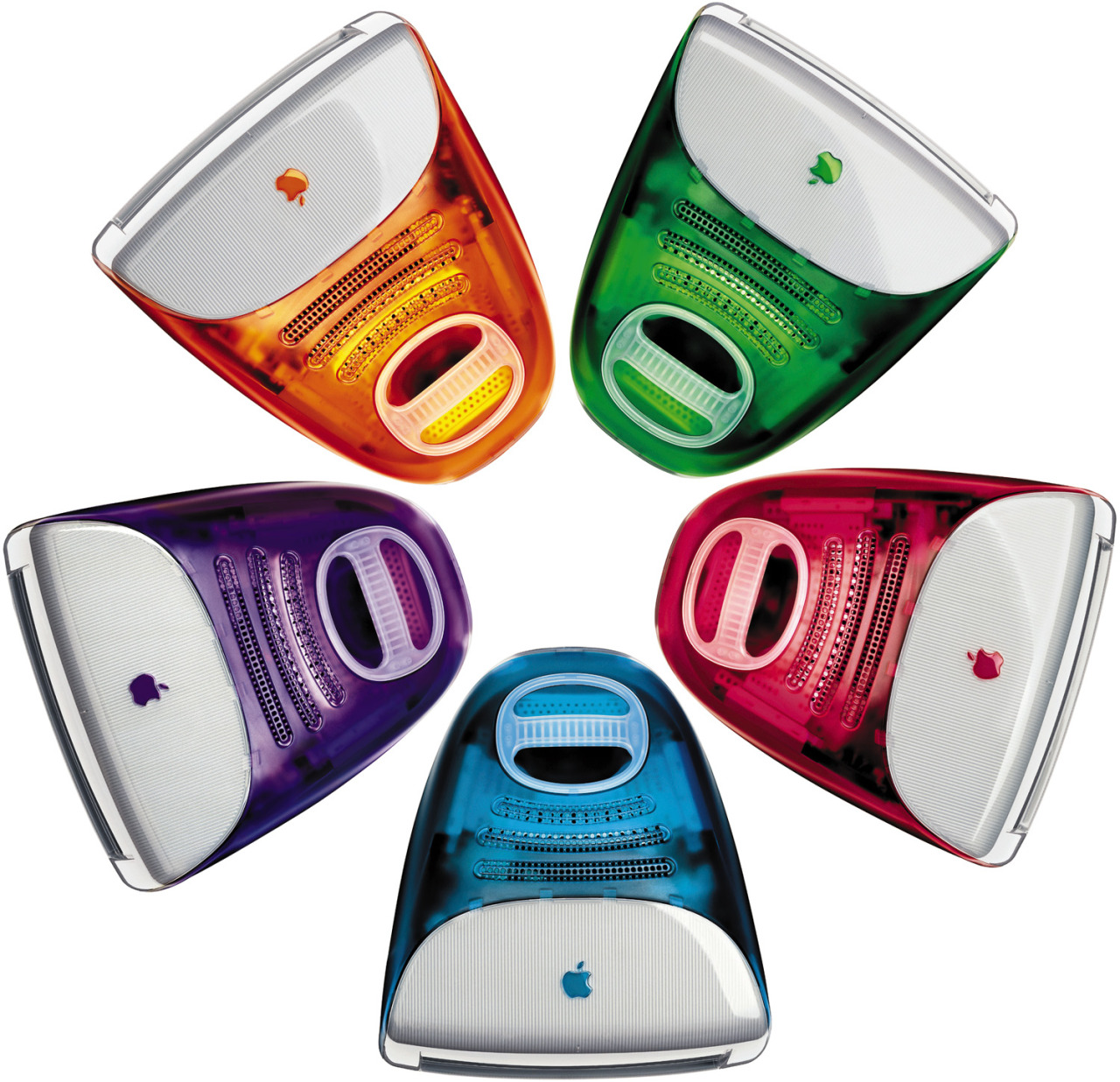
I believe this was the photo. Back then, in the early days of internet adoption, computers were still housed in the same old stodgy rectangular steel cases. I already had an IBM-compatible PC and it was perfectly sufficient for my needs, yet the iMac stirred an “I want it” impulse on its design alone. And I wasn’t the only one shocked by it. Among my friends who were interested in computers, mere middle schoolers at the time, everyone was talking about the iMac, debating whether we could ever own one and what we could even use it for. Of course, for all of us, the iMac was pie in the sky. Meanwhile, one gaming magazine that delivered industry news to people my age at the time ran an article like this. As I recall, it went roughly like this: “Up until the mid-90s, Steve Jobs was the man in the industry most likely to make the news for taking his own life. He’d been ousted from Apple, NeXT had failed, and the industry had been seized by IBM, Microsoft, Compaq, Dell, and the like. But now he’s returned to Apple, and the iMac has been a success.”
In 2000, as ADSL networks were being rolled out nationwide, my friends and I were obsessed with illegally downloading music as mp3 files through Soribada. A few friends even shelled out big money to get themselves mp3 players. The reasoning was that downloading music (illegally) as mp3s let you save money compared to buying albums on tape or CD. Of course, the storage capacity of mp3 players back then was paltry. Around 64MB was considered a fairly decent amount of storage, and based on the mp3 files commonly floating around on Soribada at the time, you could fit more than 15 songs. It wasn’t until late 2001 that I managed to get my own mp3 player, which had 128MB of storage and cost under 200,000 won. The iPod was already out at the time, but it was too expensive, so it was never even a consideration for me to begin with. On top of that, in Korea, iriver had swept the mp3 player market with its triangular-prism design, so the iPod made barely a ripple. Thanks to the regional peculiarities of Korea, I was able to go on forgetting about Apple.
Now I’ll skip ahead a good while. In 2009 I was a university student, a returning student who had just been discharged from the military. In a course I was taking called “Management Information Systems,” the professor assigned us to watch and summarize Steve Jobs’s product launch videos from the past decade or so. By this point, every video was easily available on YouTube. Having just returned from the military, I was an exceedingly diligent student, so I worked hard on the assignment. And I became an Apple fanboy.
As it happened, the latter half of 2009 was the year the first iPhone finally launched in Korea. At the time, there was a lot of talk: that the iPhone’s capacitive touchscreen wasn’t suited to Korean conditions, that we should support domestic products, that the Omnia was obviously the best, that smartphones were still premature, and so on. Regardless, people lined up to buy the iPhone. KT sales reps set up a stand in front of the dormitory where I lived and took iPhone sign-ups. Even there, a line had formed. I wanted an iPhone too. But the iPhone was expensive, and the feature phone I was using at the time was good enough for me. Of course, everyone knows what happened after that. The age began drifting toward smartphones.
Even today this is true to some degree, but back then it was an era when many people believed the kind of phone you used defined your identity, even if they weren’t consciously aware of it. And so a lot of people fought over smartphones. The fight was largely between iPhone users and Android users. The arguments of those who criticized the iPhone usually went like this: that the iPhone’s ecosystem was closed and therefore destined to fail soon, and that fundamentally its technical level was shoddy relative to its steep price. Many people even dismissed the achievements of Jobs and the iPhone as trivial and not something that could be called innovation. When the iPad came out in 2010, many people mocked Jobs. A doctored photo of four iPhones taped together with Scotch tape made the rounds on the internet. Of course, in hindsight, it was all foolish talk. Whether they praised or vilified Jobs and Apple, all of this fighting was itself proof that this was an age led by Apple.
It wasn’t until the summer of 2011 that I bought a smartphone. The mobile phone market around that time was just as strange as it is now: if you signed a contract to stay with a carrier for two years, they’d give you the latest phone for free. My two-year carrier contract happened to be expiring, so I was looking for a new phone. There wasn’t much to deliberate over. The Samsung Galaxy S2 was free. The iPhone, you had to pay full price for. As long as a phone could run KakaoTalk, I didn’t care, and by my standards the Galaxy S2 was more than enough machine. But after holding the smartphone in my hand and using it for a few days, I realized this was genuine innovation. My way of life changed dramatically because of it. That October, Jobs died.
Another two years passed. When my two-year carrier contract ended and I had to change phones, I chose the iPhone 5. It had been released a generation earlier, so it was being given away for free. It was my first Apple device. On my first day holding the iPhone, I grumbled because of the unfamiliar way it operated. Seeing this, one of my friends said to me, “Before the light of day breaks tomorrow, you will deny Android three times.” And so it came to pass. What had seemed like an unfamiliar way of operating was, in fact, the best way of operating. From then on I became an Apple fanboy, someone who couldn’t live without Apple devices. I use an iPhone, an iPad, an Apple Watch, and a MacBook, and I even make a living building iOS apps.
Can a greedy merchant make the world a better place? I believe he can.
20200222

Leave a comment